Stalin signals patience as Vijay’s TVK scrambles for numbers in Tamil Nadu
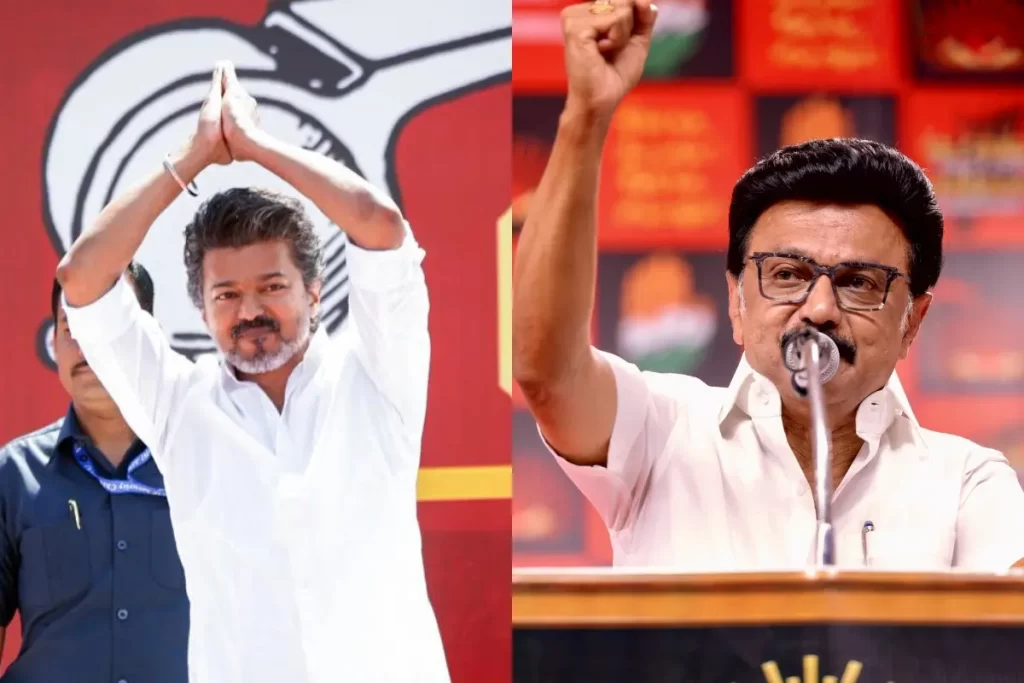
Outgoing Tamil Nadu Chief Minister M. K. Stalin struck a cautious yet measured tone on Wednesday as actor-turned-politician Vijay moved closer to power after a dramatic election debut.
Speaking after the Assembly results reshaped Tamil Nadu politics, Stalin said the Tamilaga Vettri Kazhagam should get an opportunity to form the government if it secures enough support. He also said the DMK would observe the new administration for six months without creating obstacles.
His remarks came at a tense political moment. TVK emerged as the single-largest party in the 234-member Assembly with 108 seats. However, the party still needs 10 more lawmakers to cross the majority mark of 118.
Meanwhile, Congress extended support with its five MLAs. Yet that number still falls short. As a result, Vijay and his team continue talks with smaller parties and independent legislators.
Across Chennai, political activity intensified through the day. Outside Raj Bhavan, TVK supporters gathered in large numbers and raised slogans in favour of Vijay. Several party workers described the election result as a “political revolution” that ended decades of dominance by the DMK and AIADMK.
Inside the power corridors, however, uncertainty remained.
Vijay met Tamil Nadu Governor R. N. Ravi and submitted documents claiming support from TVK and Congress legislators. Even then, Raj Bhavan did not immediately invite him to form the government. Officials reportedly sought legal opinion before taking the next step.
Ground reports from Chennai showed growing curiosity among voters as negotiations continued behind closed doors. Tea stalls, bus stops and local markets buzzed with discussions about whether Vijay could convert his electoral momentum into a stable government.
For many first-time voters, the result marked a major political shift. TVK attracted strong support from urban youth, women voters and sections of the middle class during the campaign. Party volunteers also built a massive grassroots network in several districts over the past year.
At the same time, Stalin used his comments to defend the welfare record of the outgoing Dravida Munnetra Kazhagam government. He urged any future administration to continue flagship schemes such as the free breakfast programme for schoolchildren and the monthly financial assistance scheme for women heads of households.
He also questioned whether TVK could fulfil several of its ambitious poll promises. Vijay had pledged ₹2,500 monthly support for women and six free LPG cylinders annually for ration-card holders. Stalin argued that such commitments could strain state finances.
Furthermore, he claimed the DMK focused only on promises it could realistically implement. He pointed to welfare schemes launched during his tenure and said the government delivered most of its 2021 manifesto commitments. However, he admitted that issues like scrapping NEET remained outside the state’s control because of central laws.
The election itself transformed Tamil Nadu’s political landscape. For nearly five decades, the DMK and AIADMK dominated the state’s power structure. This election disrupted that pattern for the first time on such a scale.
Vijay’s rise from cinema icon to political contender also changed campaign dynamics. Huge crowds attended his rallies across the state. His speeches focused on corruption, unemployment and welfare expansion. In many constituencies, TVK candidates defeated experienced leaders from established parties.
Still, the final hurdle now lies in numbers.
Until TVK secures enough lawmakers, Tamil Nadu remains in political suspense. Even so, Stalin’s latest remarks suggest the DMK may avoid direct confrontation for now and instead wait to see whether Vijay can transform electoral excitement into a functioning government.