Vijay’s power push stalls as numbers slip; Tamil Nadu faces another night of political uncertainty
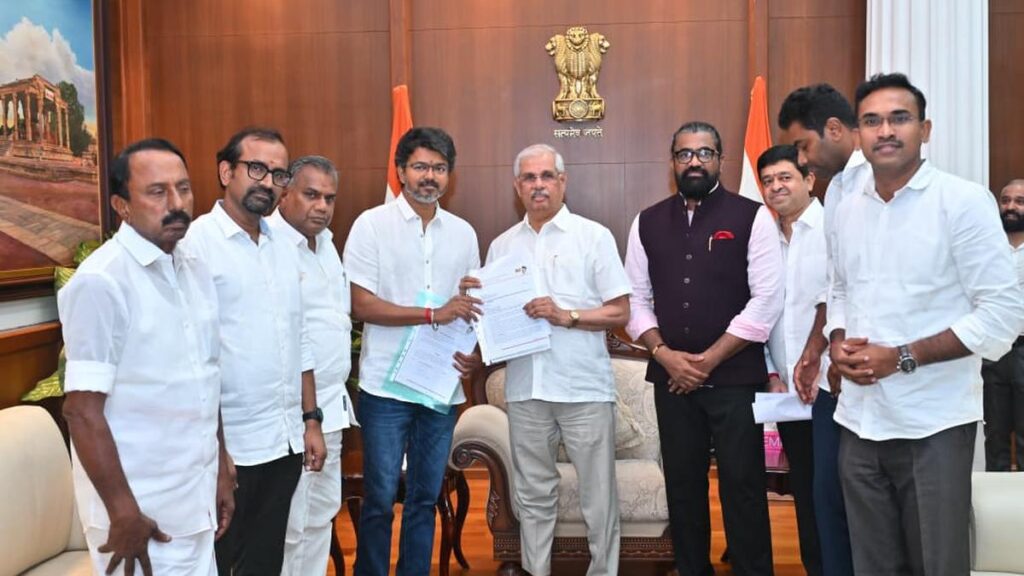
Chennai witnessed another dramatic political twist on Friday night as actor-turned-politician Vijay came close to forming a government but failed to cross the majority line at the final moment. What looked certain by afternoon turned uncertain within hours, and the expected swearing-in ceremony now stands cancelled.
Throughout the day, cadres of Tamilaga Vettri Kazhagam celebrated outside Vijay’s Panayur residence. Supporters burst crackers, distributed sweets and raised slogans as party leaders claimed they had secured enough backing to form the next government in Tamil Nadu. Workers from several districts even began arriving in Chennai after hearing that Vijay could take oath on Saturday morning.
Initially, TVK leaders counted support from the Congress, CPI and CPI(M). They also expected the backing of the VCK and the IUML. Together, the camp believed the numbers had crossed the crucial 118-seat mark in the Assembly.
However, the situation changed by evening.
Political sources said VCK chief Thol. Thirumavalavan did not submit a formal support letter to Governor Rajendra Arlekar despite earlier public remarks that his party would follow the Left parties’ stand. That missing letter created a fresh arithmetic problem for Vijay’s alliance.
Soon, confusion spread across Chennai’s political circles. Leaders moved between residences, hotels and party offices while speculation intensified on television debates and social media platforms. Inside the Governor’s office, officials reportedly counted only 116 MLAs in Vijay’s favour during Friday evening’s meeting. As a result, Raj Bhavan avoided moving ahead with the oath-taking process.
Meanwhile, Thirumavalavan held back-to-back discussions with senior leaders from multiple parties. He reportedly met representatives from TVK, the AIADMK camp led by Edappadi K. Palaniswami and leaders from the ruling DMK. Even late at night, meetings continued at outgoing Chief Minister M. K. Stalin’s residence in Chennai.
On the ground, uncertainty replaced celebration. Several TVK workers who gathered near Panayur waited for official confirmation deep into the night. Some supporters remained confident that the alliance would secure the missing numbers before morning. Others admitted frustration as leaders failed to provide clarity. Police presence around key political locations also increased as crowds continued to gather.
At the same time, political rumours took over the conversation. One theory circulating in VCK circles claimed that both EPS and Stalin explored the possibility of projecting Thirumavalavan himself as a compromise Chief Ministerial candidate if the deadlock continued. Though no party officially confirmed such talks, the speculation added another layer to Tamil Nadu’s already tense political atmosphere.
Then another controversy erupted.
T. T. V. Dhinakaran reached Raj Bhavan after 9 pm and alleged that horse trading had begun. Dhinakaran, whose AMMK remains part of the NDA alliance, claimed that his lone MLA, Kamaraj, had gone missing. He told reporters that the MLA stopped answering calls and alleged that someone might have taken away his phone.
The complaint immediately triggered concern because every MLA now carries enormous political value in the current numbers game. Soon after, Governor Arlekar directed the state DGP to trace the missing legislator and seek a report. Following that development, authorities dropped plans for Saturday’s swearing-in ceremony.
The latest turmoil once again highlights Tamil Nadu’s rapidly changing political landscape after the Assembly verdict produced a fractured mandate. Vijay entered politics with promises of clean governance and alternative leadership, and his party’s strong electoral performance shocked several established players. Yet, the current crisis shows how alliance politics and last-minute negotiations still shape power equations in the state.
For now, Tamil Nadu remains without clarity on who will form the next government. Political leaders continue negotiations behind closed doors, while party workers and voters wait for the next twist in a fast-moving political drama.