Pilot, co-pilot killed after jet collides with fire truck at New York’s LaGuardia airport
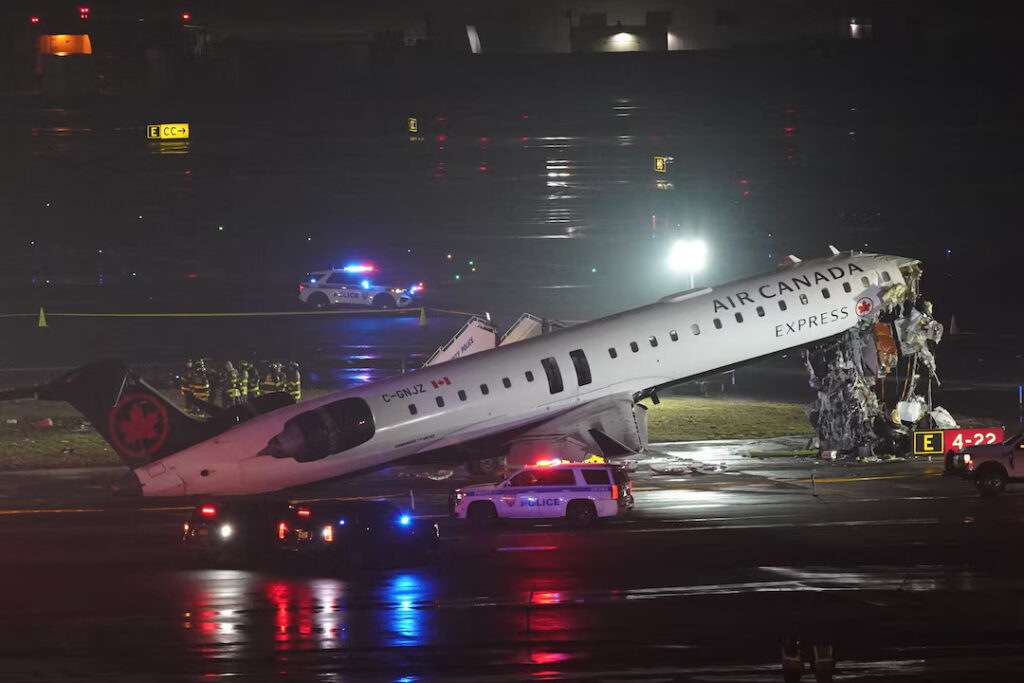
New York – A late-night landing at LaGuardia Airport turned into a deadly हादसा on Sunday as an Air Canada Express aircraft struck a ground firefighting vehicle. The collision killed both pilots and left several passengers and crew injured. Authorities quickly sealed the airport and launched an urgent investigation.
To begin with, the regional jet arrived from Montreal and approached the runway under routine conditions. The aircraft, operated by Jazz Aviation, touched down shortly before midnight. However, within moments, it hit a fire truck positioned on the runway. Officials confirmed that the impact occurred during landing operations.
Soon after, emergency teams rushed to the site. They pulled injured passengers and crew members from the aircraft. Meanwhile, medical teams shifted the wounded to nearby hospitals. Reports confirmed that dozens sustained injuries, though most remained stable.
Tragically, the cockpit crew did not survive. The pilot and co-pilot lost their lives in the crash. Investigators believe the force of the collision caused fatal damage to the front section of the plane. At the same time, the fire truck crew also suffered injuries. A police sergeant and an officer onboard the vehicle sustained fractures but remained out of danger.
According to preliminary data, the aircraft carried 72 passengers and four crew members. Flight tracking systems showed that the jet landed at around 11:37 p.m. local time. It then moved along the runway at approximately 24 miles per hour before striking the vehicle. This detail now forms a key part of the investigation.
On the ground, the impact left visible damage. Images from the scene showed a crushed nose section of the aircraft. The front of the jet tilted upward after the collision. Debris scattered across the runway, forcing authorities to halt all operations immediately.
As a result, the Federal Aviation Administration stepped in and ordered a ground stop. Officials shut down incoming flights at LaGuardia Airport to clear the runway and support rescue work. Consequently, airlines diverted several flights to nearby airports. Some flights returned to their origin points, while others landed at alternate hubs across the region.
Passengers inside the aircraft described moments of panic. Many reported a sudden jolt followed by chaos in the cabin. Crew members guided passengers toward emergency exits. First responders then assisted in evacuation and provided immediate medical care.
From a broader perspective, the incident raises serious questions about runway safety and coordination. Airports follow strict protocols to separate aircraft and ground vehicles. However, this collision suggests a possible lapse in communication or timing. Investigators will now examine air traffic control records, vehicle movement logs, and cockpit data.
Meanwhile, authorities have started a full-scale probe. Teams will analyze the sequence of events leading to the crash. They will also inspect the condition of the aircraft and the fire truck. Officials have not yet confirmed the exact cause, but they aim to establish accountability and prevent future incidents.
LaGuardia Airport plays a crucial role in New York’s aviation network. In 2025 alone, it handled more than 30 million passengers. Therefore, any disruption at this hub creates a ripple effect across the region. Following the crash, the airport remained closed for several hours as crews cleared debris and secured the area.
At the ground level, the shutdown created immediate challenges. Travelers faced delays and uncertainty. Airlines worked overnight to adjust schedules and manage passenger flow. Airport staff coordinated with multiple agencies to restore operations as quickly as possible.
In the background, aviation safety has remained a top priority in the United States. Authorities enforce strict rules for runway access and aircraft movement. Despite these measures, rare incidents like this highlight the risks that persist in complex airport environments.
Looking ahead, officials will focus on key questions. They will examine how the fire truck reached the runway during landing operations. They will also review whether communication gaps contributed to the crash. Findings from this probe could lead to updated safety protocols across airports.
In conclusion, the LaGuardia collision marks a tragic moment in aviation safety. The loss of two pilots underscores the severity of the incident. At the same time, the quick response from emergency teams helped prevent further casualties. As investigators continue their work, the aviation community will watch closely for answers and reforms.