PM Modi calls for Human-Centric and Democratised AI at India AI Impact Summit 2026
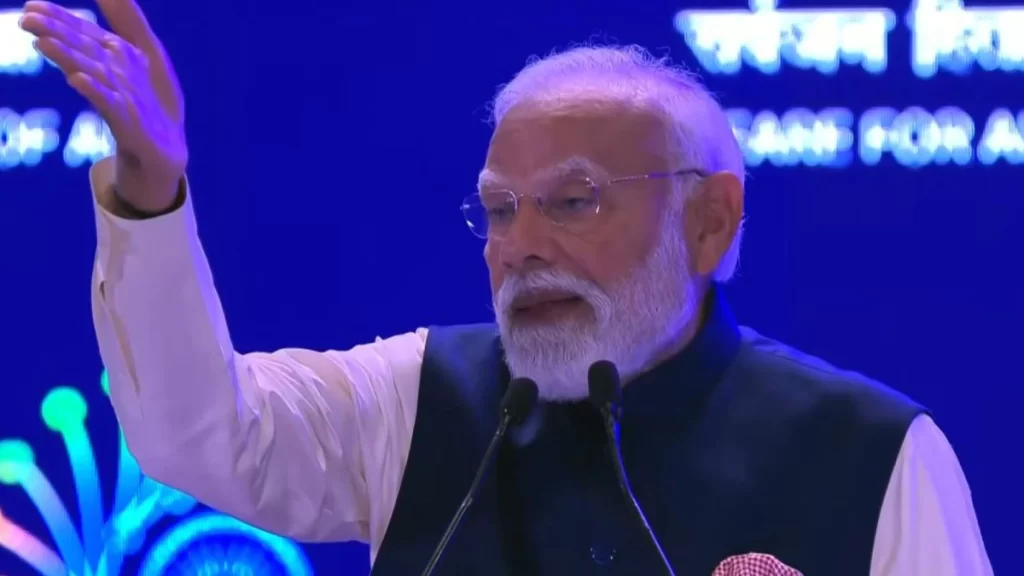
Prime Minister Narendra Modi on Thursday outlined a bold vision for artificial intelligence at the India AI Impact Summit 2026. He addressed global leaders and technology experts at Bharat Mandapam in New Delhi. He urged the world to steer AI in the “right direction” and ensure that it benefits everyone.
First, he placed AI in historical context. He recalled the journey from early wireless communication to today’s real-time global connectivity. Then, he described AI as another major transformation in human history. He said the world now stands at the beginning of AI’s true impact. According to him, this phase will reshape societies at unprecedented speed and scale.
Next, he stressed inclusivity. He argued that AI will serve humanity only when everyone shares it. He called for open code and broad participation. He said AI must not remain limited to a few companies or countries. Instead, he urged policymakers and developers to widen access and opportunity.
Moreover, he clarified that AI does more than build smarter machines. He said AI multiplies human capability. He pointed out that earlier technological revolutions took decades to show results. In contrast, AI evolves faster and spreads deeper. Machine learning, he noted, has already moved toward systems that learn and adapt with remarkable speed.
However, he warned against directionless growth. He said technology without vision can disrupt societies. Therefore, he asked leaders to carry equal responsibility. He insisted that governments and institutions must decide what kind of AI they will pass on to future generations. He shifted the debate from “What can AI do?” to “What can humans do with AI today?”
Then, he highlighted workforce readiness. He called for mass movements around skilling, reskilling, and lifelong learning. He said the future of work must remain inclusive and human-centric. According to him, societies must prepare workers for rapid technological shifts. He argued that collaboration will unlock AI’s full potential.
Furthermore, he pressed for democratisation. He said AI must move from machine-centric systems to human-centric solutions. He warned against reducing individuals to mere data points. Instead, he urged stakeholders to treat AI as a tool for empowerment. He emphasized support for developing nations, especially across the Global South. He said AI can bridge divides if leaders design it with inclusion in mind.
To explain his approach, he used a practical analogy. He compared AI to GPS navigation. GPS suggests routes, but humans make final decisions. Similarly, he said humans must retain control over AI systems. He argued that today’s choices will shape tomorrow’s outcomes.
In addition, he called for global standards. He urged world leaders to treat AI as a global common good. He emphasized cooperation across borders. He said shared frameworks will build trust and stability in digital ecosystems.
Finally, he addressed risks from deepfakes and fabricated content. He warned that misinformation threatens public trust. Therefore, he asked the technology industry to introduce authenticity labels and watermarking standards. He insisted that developers must embed trust mechanisms at the design stage itself.
In conclusion, the prime minister presented AI as both opportunity and responsibility. He encouraged innovation. At the same time, he demanded ethical safeguards. He framed AI not as a race for dominance, but as a shared journey for human advancement.