Rahul Gandhi flags ‘Institutional Assault’ abroad, BJP hits back with propaganda charge
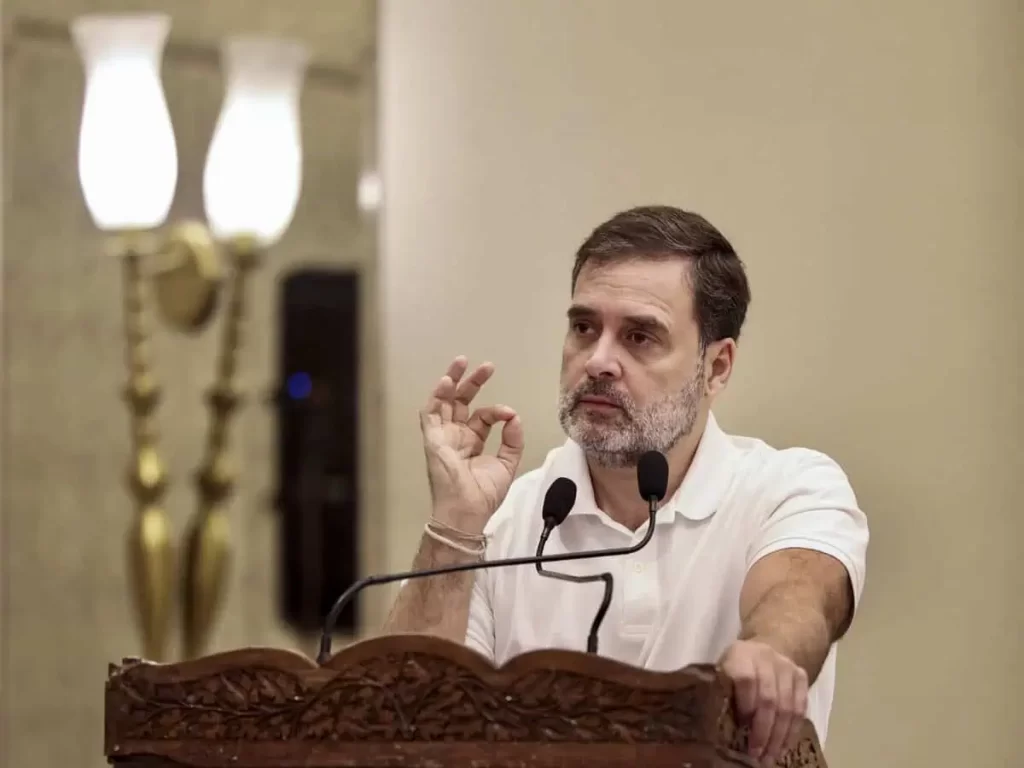
Rahul Gandhi has reignited a fierce political debate over India’s institutions. Speaking at the Hertie School in Berlin, the Leader of the Opposition said the country’s institutional framework faces sustained pressure. He argued that powerful bodies now work to benefit the ruling Bharatiya Janata Party. His remarks abroad triggered an immediate and sharp response from the BJP.
Gandhi framed his argument around elections and oversight agencies. First, he questioned the integrity of the electoral system. Then, he accused the government of capturing key institutions. He named intelligence agencies, the Central Bureau of Investigation, and the Enforcement Directorate. According to him, these bodies no longer act independently. Instead, he said, they function as political tools.
He pointed to case data to support his claim. Gandhi said agencies rarely pursue BJP leaders. In contrast, he said, they target opposition figures in large numbers. As a result, he argued, fear shapes political competition in India. He added that such an environment weakens democracy.
Next, Gandhi drew a contrast between Congress and the BJP. He said Congress helped build India’s institutions. Therefore, he claimed, the party never treated them as private assets. However, he accused the BJP of doing exactly that. He said the ruling party views institutions as instruments of power. Consequently, he argued, the system now tilts heavily in one direction.
Gandhi also raised the issue of political funding. He highlighted the gap between BJP resources and opposition funds. He claimed the ratio stands at roughly 30 to 1. Because of this imbalance, he said, elections no longer offer a level playing field. Still, he stressed that the opposition must respond with strategy, not complaints.
Then, he spoke about resistance. Gandhi said the opposition cannot stop at pointing out flaws. Instead, he urged the creation of a structured method to counter institutional misuse. According to him, this challenge goes beyond routine electoral politics. It now involves protecting an alternative idea of India.
When asked about the INDIA alliance, Gandhi clarified its foundation. He said observers often link alliances only to election timing. However, he argued that ideology binds the INDIA bloc. He said member parties reject the core ideology of the RSS. On that issue, he claimed, unity remains strong. At the same time, he admitted tactical contests exist among allies.
Despite differences, Gandhi underlined parliamentary unity. He said opposition parties often act together inside Parliament. They challenge laws they oppose. More importantly, he said, they fight for a different national vision. In his view, the battle now runs deeper than votes.
The BJP reacted strongly to Gandhi’s remarks. Party president and Union minister JP Nadda accused him of insulting India on foreign soil. Nadda pointed out that Parliament remained in session while Gandhi spoke in Germany. He also contrasted Gandhi’s comments with what he called growing global respect for Prime Minister Narendra Modi.
BJP spokesperson Shehzad Poonawalla escalated the attack. He accused Gandhi of running a “Defame India” campaign abroad. He said Gandhi spreads falsehoods about manufacturing and institutions. He also criticised Gandhi for praising China while criticising India. According to Poonawalla, Gandhi acts less like an opposition leader and more like a propagandist.
Thus, Gandhi’s Berlin speech has widened the political divide. While the Congress leader frames the issue as a democratic struggle, the BJP paints it as national defamation. The clash now plays out both at home and abroad.