Farmers shift stubble-burning to 5 PM, outsmart satellites; new studies challenge Govt’s clean-air claims
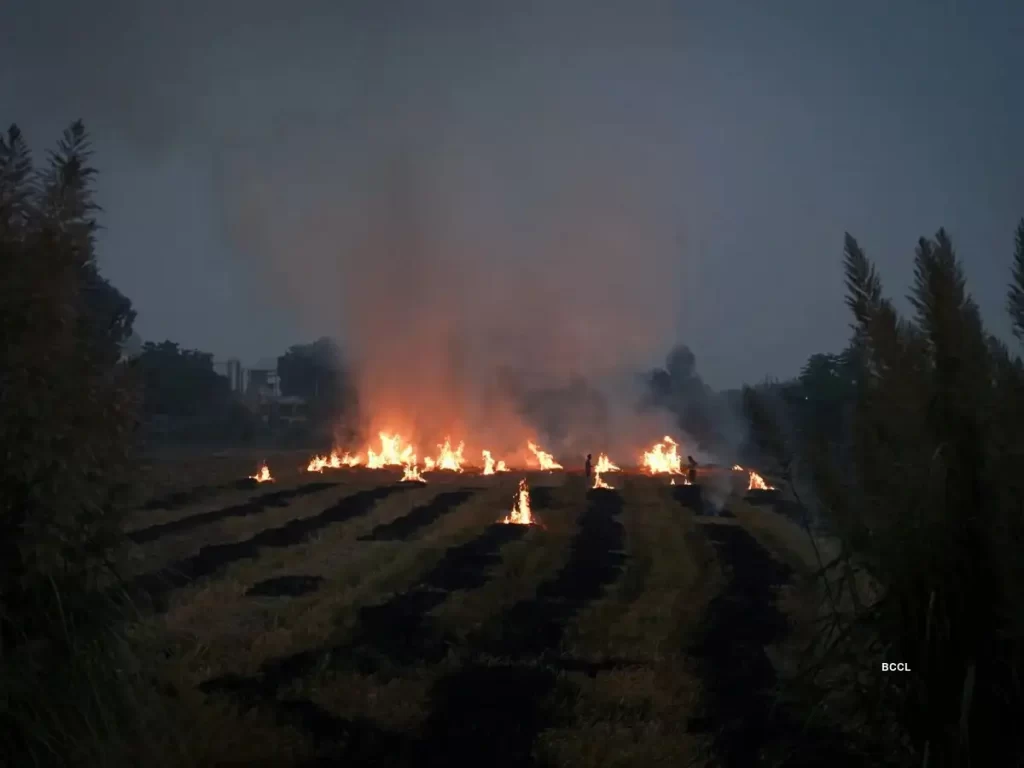
India entered another winter pollution cycle with a fresh controversy over stubble-burning data. This time, new scientific findings challenge the belief that farm fires in Punjab and Haryana dropped sharply. ISRO and NASA experts now argue that farmers shifted the timing of farm fires to late evening to escape satellite monitoring. This shift raises urgent questions about the accuracy of official data, the credibility of pollution-control claims, and the future of air-quality management in Delhi-NCR.
To understand the loophole, one must track how satellites observe the Earth. Polar-orbiting satellites scan India only twice every 24 hours. They pass over Punjab and Haryana in the late morning and early afternoon. Farmers eventually learned this schedule. Subsequently, they delayed stubble-burning until after 4.30 PM, when these satellites no longer scanned their fields. Scientists say this tactic created the illusion of a dramatic drop in farm fires.
ISRO’s Space Applications Centre highlighted this shift in a recent study. The researchers tracked fire activity patterns from 2020 to 2024. They noticed a steady shift in peak burning time. Farmers earlier lit fires around 1:30 PM. However, by 2024, the peak moved to nearly 5 PM. The researchers concluded that farmers adapted deliberately to avoid satellite detection. They also found that the window of burning narrowed, suggesting a coordinated adjustment on the ground.
NASA scientist Hiren Jethva reached a similar conclusion. He used data from a geostationary satellite that watches the region continuously. His analysis revealed a major gap between actual smoke levels and the farm fires detected by polar-orbiting satellites. He observed high aerosol levels in the air despite low fire counts. He warned that 2025 recorded the third-highest smoke load in 15 years. He argued that the official claim of a 92% reduction in Punjab’s farm fires did not hold up under close scientific scrutiny.
Meanwhile, ground investigations strengthened the satellite findings. In late November, India Today reporters visited villages in Punjab. They found farmers openly admitting the late-evening burning tactic. Local patwaris and agricultural officers confirmed that farmers waited until after 4 PM. They explained that satellites passed the region in a narrow window, and farmers adjusted their timing accordingly. These admissions aligned with the ISRO and NASA findings.
Despite this evidence, the government insists that farm fires declined significantly. Union Environment Minister Bhupender Yadav told Parliament that Punjab and Haryana recorded nearly 90% fewer stubble-burning incidents in 2025 compared to 2022. The government based its data on inputs from agencies that used polar-orbiting satellites. These satellites, however, missed most late-evening fires. This mismatch created a dispute between ground reality and official interpretation.
The Ministry of Environment later said that Punjab recorded just over 5,100 fires in 2025. It credited the reduction to strict enforcement measures, machinery deployment, and district-level action plans. The government cited year-on-year improvements and presented them as evidence of successful intervention. However, the scientific community questioned that narrative. They pointed out that delays in burning simply shifted the fires out of the satellites’ limited viewing window.
Stubble-burning remains one of many contributors to Delhi’s toxic winter air. Vehicle emissions, industrial smoke, construction dust, and weather patterns also worsen pollution. Yet farm fires add a significant seasonal spike in November and December. When fires go undetected, policymakers misjudge the severity of the situation. Consequently, they design ineffective responses.
The new research emphasizes the need for continuous monitoring systems. Geostationary satellites can fill the gaps left by polar-orbiting ones. They can track fires in real time and produce more accurate emission estimates. Without updated monitoring tools, the government risks forming policies based on incomplete data.
Delhi’s pollution crisis demands clarity, accountability, and scientific accuracy. Farmers burn stubble because they lack cost-effective alternatives. The government enforces rules but depends on imperfect data. Scientists push for better tools but struggle against bureaucratic inertia. Millions of people breathe toxic air while these contradictions deepen.
As the findings show, the crisis cannot be solved with misleading numbers. The real picture emerges only when experts, governments, and farmers confront the ground truth. If the government adopts updated monitoring methods and supports sustainable farming practices, it can finally address crop-burning at its source. Without that commitment, the cycle of smoke, blame, and denial will continue each winter.
The latest ISRO and NASA insights offer a chance to correct course. Whether the government listens will decide the air quality of North India’s future.