After 20 Years, Nitish Kumar drops home portfolio as NDA reshapes Bihar’s power structure
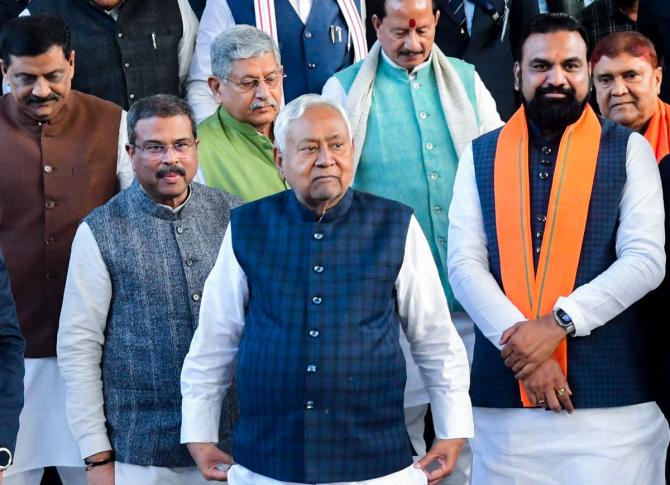
Patna — Bihar witnessed a major political shift as Chief Minister Nitish Kumar gave up the Home Ministry for the first time in nearly two decades. The NDA government appointed Samrat Choudhary as the new Home Minister and signaled a fresh power equation inside the alliance. The move surprised many because Nitish held the Home portfolio since his early years in power.
To begin with, Samrat Choudhary took charge of policing, law and order, intelligence, and internal security. He now leads the entire police administration. All officers, including the DGP, report directly to him. Senior journalist Love Kumar Mishra linked this appointment to Choudhary’s rising political stature and the BJP’s growing weight inside the NDA.
Even so, Nitish Kumar strengthened his grip on the administrative core. He retained General Administration, Cabinet Secretariat, Vigilance, the Election Department, and all non-allotted portfolios. The General Administration Department controls postings, transfers, and senior-level appointments. It also supervises district magistrates and secretaries. Therefore, Nitish continues to hold the state’s most powerful levers.
Next, the new structure created an interesting administrative design. Samrat Choudhary directs police and internal security. However, district SPs must coordinate with DMs on ground-level decisions. DMs report directly to the General Administration Department under the Chief Minister. As a result, the final command stays with Nitish Kumar. This design gives the BJP operational authority but keeps the ultimate control with the Chief Minister.
Meanwhile, political circles read the move as a calculated strategy. The NDA projected BJP’s enhanced status by giving it the Home Ministry. At the same time, the alliance placed Samrat Choudhary at the center of its preparations for the 2025 Assembly polls and the 2029 Lok Sabha elections. Nitish Kumar, however, ensured that he did not dilute his influence over bureaucracy and decision-making.
Furthermore, party insiders said Nitish wanted to reward the BJP after its strong electoral performance. Yet he shaped the governance model in a way that preserved his central role. The BJP welcomed the move as an expansion of its administrative footprint. JDU leaders viewed it as a balanced distribution of power that strengthens the coalition ahead of key political battles.
In addition, administrative officers expect smoother coordination between policing and general administration. They believe clear divisions of responsibility will help manage law-and-order situations more efficiently. Critics, though, warned about potential friction if both departments assert competing priorities. Supporters argued that Nitish’s long experience and Choudhary’s assertive leadership would keep the system stable.
In the end, the reshuffle clarified Bihar’s political landscape. The BJP now directs the Home Ministry, while Nitish Kumar controls the state’s entire administrative backbone. The NDA presented the decision as a united step forward. Yet the arrangement also reveals a familiar Nitish formula: share space, keep authority, and shape the power balance on his terms. The coming months will show how this new structure influences Bihar’s political climate ahead of 2025.