Delhi records ‘very poor’ air yet again, while Ghaziabad slips into ‘severe’ zone as cold wave deepens
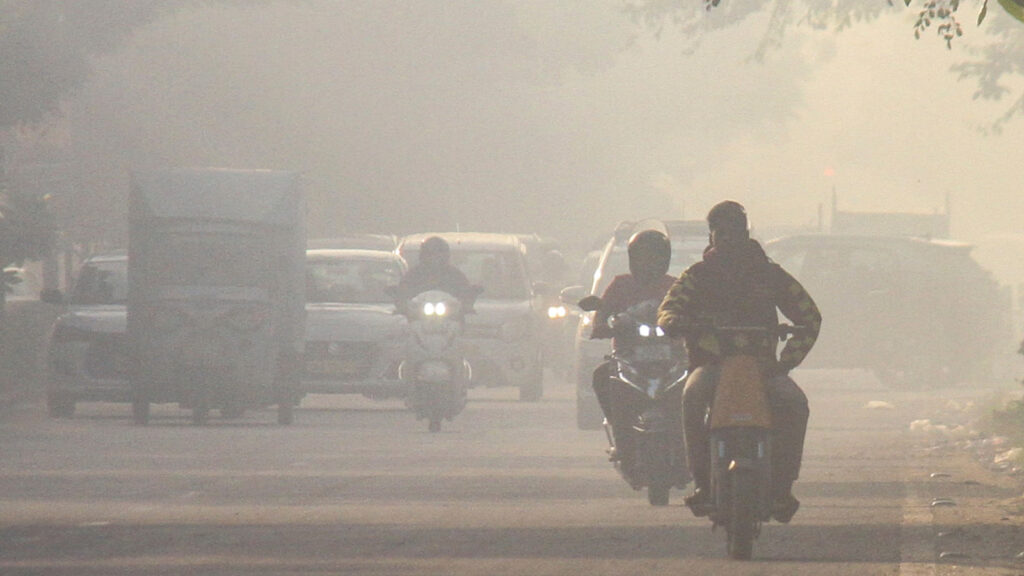
New Delhi – Delhi continued to choke under ‘very poor’ air on Tuesday. The city registered an AQI of 341 at 6 a.m., slightly better than Monday’s 359 and Sunday’s 377. Winds picked up speed over the weekend and helped marginally. Even then, toxic air covered most parts of Delhi and its neighbouring regions.
The city also battled sharp winter chill. Delhi recorded a minimum temperature of 8.7°C on Monday, four degrees below normal. This was the lowest November temperature since 2022, when the mercury slipped to 8.3°C on November 30. The maximum temperature stayed at 27.1°C.
By early Tuesday, several neighbourhoods saw severe pollution levels. Wazirpur touched 410, Bawana 419, and Jahangirpuri 414. These numbers came from the Central Pollution Control Board’s Sameer app. The data confirmed that pollution hotspots continued to worsen even as the overall AQI improved slightly.
Forecast models predicted no relief. The Early Warning System under the Ministry of Earth Sciences warned that Delhi’s air will remain ‘very poor’ from November 18 to November 20. It further noted that the AQI may slip back into the ‘severe’ zone by Wednesday. Officials said the wind pattern will weaken again, which will trap pollutants.
Authorities have already activated Stage 3 restrictions under the Graded Response Action Plan. These curbs started on November 11 when the AQI hit 428. Under Stage 3, agencies halt construction activities that generate dust, limit industrial pollution, and intensify road cleaning. Despite these steps, particulate levels remain high.
Meanwhile, Ghaziabad overtook all other cities. It became India’s most polluted city on Monday. The CPCB bulletin listed its AQI at 401, driven mainly by PM2.5. Local clusters showed even worse readings. Indirapuram logged 365, Loni 414, and Sanjay Nagar 433. Vasundhara’s data could not be recorded due to a technical glitch. Sunday marked the city’s first ‘severe’ air day of 2025. The last such day came on December 17, 2024, when the AQI reached 403.
While pollution levels worsened, the Supreme Court heard arguments on fresh control measures. Senior advocate Gopal Sankaranarayanan urged the court to impose tough steps. He claimed Delhi had turned into a “gas chamber.” But the court refused to order blanket restrictions. Chief Justice Bhushan R. Gavai said the capital “cannot be brought to a standstill.”
The bench also included Justices K. Vinod Chandran and N. V. Anjaria. They agreed that the fight against pollution must not harm daily-wage workers. They noted that thousands of migrants from Bihar and Uttar Pradesh rely on continuous work. “The solution cannot be worse than the problem,” the bench said.
Delhi continues to battle sliding temperatures, weak winds, and rising emissions. Ghaziabad faces a sharper crisis. Both cities now wait for stronger winds or rain to break the cycle of toxic winter air.