US eases H-1B fee rules, major relief for Indian techies and students
The United States Citizenship and Immigration Services (USCIS) on Monday clarified that international graduates and professionals already in the country will not pay the steep $100,000 H-1B visa fee announced last month. The decision brought huge relief to thousands of Indian techies and students facing uncertainty since the Trump administration introduced the fee.
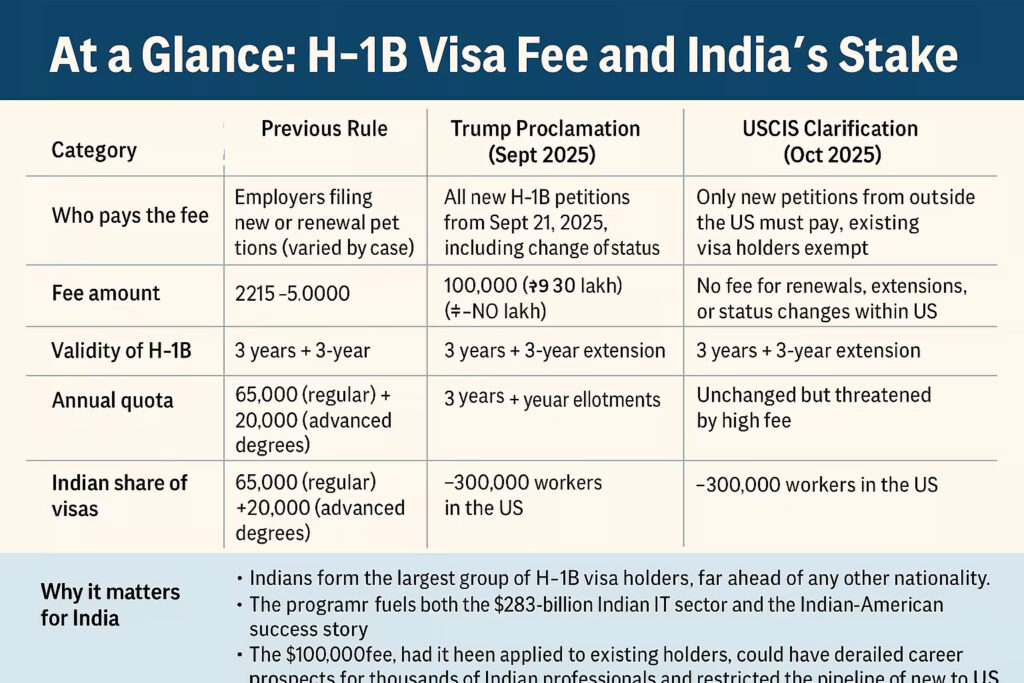
The clarification ended weeks of confusion that followed the proclamation. The earlier order mandated employers to pay the hefty annual fee—about ₹90 lakh—for sponsoring technically skilled foreign workers. The rule was set to take effect from September 21, sparking panic among Indian employees, US-based companies, and immigration lawyers.
Relief for Current Visa Holders
In its latest guidance, USCIS said the new fee will not apply to anyone already in the United States on valid visas. The exemption covers F-1 student visa holders, L-1 transferees, and current H-1B professionals renewing or extending their status.
The agency stated that the proclamation affects only new petitions filed after 12:01 a.m. ET on September 21, 2025. It further confirmed that existing H-1B holders can continue traveling in and out of the US without restriction. This clarification eased major concerns about disruptions to ongoing projects and travel plans.
USCIS also confirmed that international students transitioning from F-1 to H-1B status do not need to pay the new fee. Officials emphasized that the policy aims to maintain fairness while preventing unnecessary burdens on legitimate foreign workers.
Why Indians Felt the Heat
The update especially benefits Indian tech professionals, who dominate the H-1B visa program. Over 300,000 Indians currently work in the US under this visa, mostly in the technology and services sectors. Indians account for nearly 70% of new H-1B visas, far ahead of Chinese nationals, who hold about 12%.
The H-1B program allows highly skilled workers to stay and work in the US for up to six years. Until now, visa costs ranged from $215 to $5,000 depending on company size. The $100,000 fee would have been up to 100 times higher. Analysts warned it could cripple the program, especially for startups and smaller employers.
Impact on Indian-Americans
For many Indian families, the H-1B visa remains a path to long-term stability in the US. Researchers behind The Other One Percent noted that the visa enabled Indian-Americans to become one of the most educated and high-earning communities in the country.
Including dependents, H-1B holders make up about a quarter of the three-million-strong Indian-American population. Indian IT firms like Infosys, TCS, and Wipro rely heavily on these visas to place engineers at US client sites. American giants like Google, Microsoft, and Amazon also depend on Indian H-1B talent.
Political Reactions
The $100,000 fee sparked political tension in both Washington and New Delhi. US Commerce Secretary Howard Lutnick defended it, claiming it targeted “high earners” and discouraged low-wage hiring. In India, Opposition leaders accused Prime Minister Narendra Modi of ignoring workers’ interests.
The Centre said it would study the new policy’s implications. Meanwhile, Modi, speaking in Gujarat, urged Indians to focus on self-reliance, calling dependence on foreign systems “the real enemy.”