Markets slide as Trump’s Tariffs hit; IT, Metals, Telecom lead losses
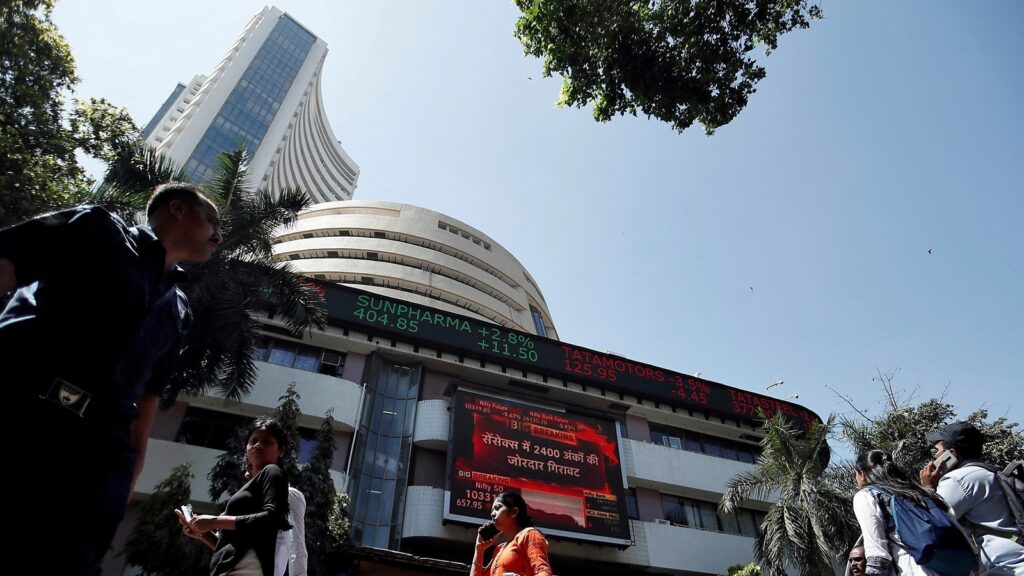
The stock market opened lower on Friday, April 4, as Donald Trump’s reciprocal tariffs took effect. IT, metal, and telecom stocks saw the biggest losses.
At 9:15 AM, the BSE Sensex dropped 325.14 points (0.43%) to 75,970.22. The NSE Nifty lost 119.35 points (0.51%) to 23,130.75.
Biggest Losers Infosys led the decline, falling 2.14% to ₹1,465. HCL Technologies followed, dropping 1.67% to ₹1,446.30. IndusInd Bank slipped 1.52% to ₹698.60. Only five of the 30 Sensex stocks traded in positive territory.
Sectoral Performance The Nifty IT Index suffered the most, falling 1.86% to 34,112.05. The Nifty Metal Index dropped 1.28% to 8,889.85. The Nifty Midsmall IT & Telecom Index lost 1.05%, settling at 8,808.30.
Previous Session Recap On Thursday, April 3, markets closed in the red. The Sensex lost 322.08 points (0.42%), ending at 76,295.36. The Nifty declined 82.25 points (0.35%) to close at 23,250.10.
“The Nifty took support near 23,141 but remains vulnerable,” said Akshay Chinchalkar, Head of Research at Axis Securities. “Bulls need to reclaim 23,440 for momentum to shift.” He added that the 22,800-23,090 range would serve as key support.
TCS led Thursday’s losses, dropping 3.98% to ₹3,403.90. Tech Mahindra followed with a 3.79% fall to ₹1,369.65. HCL Technologies slipped 3.71% to ₹1,470.80. Thirteen Sensex stocks managed to close higher.
The Nifty IT Index took the biggest hit, plunging 4.21% to 34,757.25. The Nifty Midsmall IT & Telecom Index fell 3.61% to 8,901.60, while the Nifty Auto Index dropped 1.14% to 21,164.00. Persistent Systems saw the steepest decline (9.75%), followed by Coforge (7.81%) and TCS (3.97%).
FII & DII Activity Foreign Institutional Investors (FIIs) offloaded equities worth ₹2,806 crore, while Domestic Institutional Investors (DIIs) bought shares worth ₹221.47 crore.
“India’s lower tariffs give it an edge over other Asian economies,” said Akhil Puri, Partner at Forvis Mazars. “A 27% reciprocal tariff on India versus 34% on China makes India a more attractive destination for global investors.” He emphasized the need for stable trade policies to sustain FII inflows.
Bond Market Outlook The 10-year India Government Bond remained flat but dipped ₹0.01 to ₹102.11. “The US tariffs bring global trade uncertainty, adding volatility to commodity prices and currency markets,” said Mahendra Kumar Jajoo, CIO – Fixed Income at Mirae Asset. “However, India’s bond market remains strong due to the RBI’s liquidity management.”
He noted that controlled inflation and stable interest rates make Indian bonds attractive. “Despite short-term global disruptions, India’s bond market fundamentals ensure stability,” he added.
Conclusion Markets remain under pressure as Trump’s tariffs ripple through global trade. IT, metal, and telecom stocks face the most heat. Analysts suggest watching key support and resistance levels for market direction. Meanwhile, India’s lower tariffs and stable policies could attract long-term foreign investments.