Court orders police inquiry over Congress promise to Ban Bajrang Dal
A Mumbai court took a firm step on a sensitive political row. A Magistrate directed the city police to open an inquiry into a complaint against the Congress party. The complainant challenged the party’s 2023 Karnataka manifesto. He claimed that Congress promised to ban the Bajrang Dal if it formed the government.
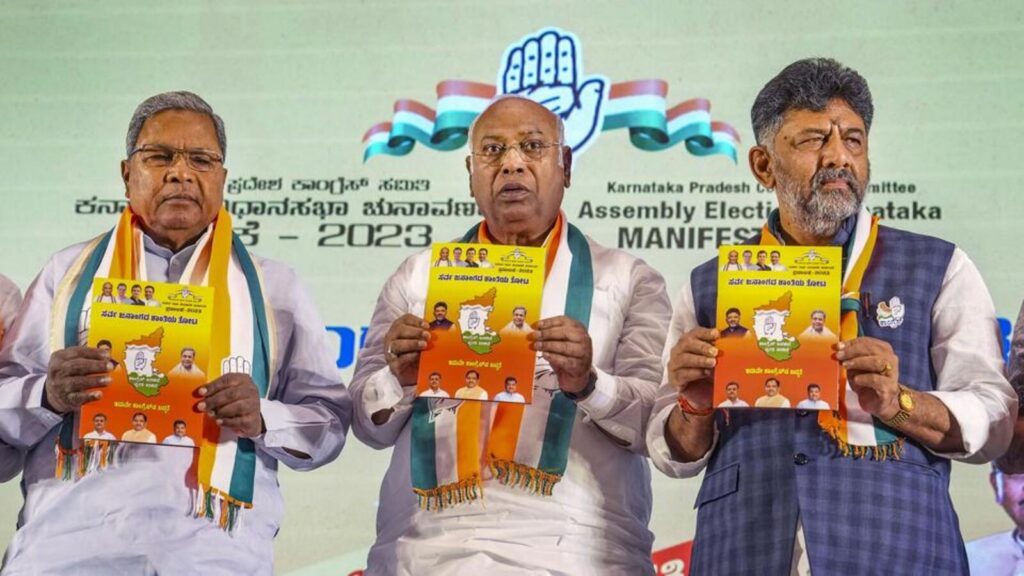
The complainant, Vashishth Narayan Baban Choudhary, filed the plea in Mumbai. He earlier served as a Bajrang Dal district coordinator in the eastern suburbs. He moved the court through advocate Santosh R. Dubey. He named several senior Congress leaders. The list included party president Mallikarjun Kharge. It also included Karnataka Chief Minister Siddaramaiah and Deputy Chief Minister D.K. Shivakumar.
According to the complaint, the leaders released the manifesto in May 2023. The release came just days before the Assembly election. The document said the party would take steps to ban Bajrang Dal. Choudhary said the promise shocked him. He said the party compared Bajrang Dal with the Popular Front of India. He added that PFI engaged in anti-India activities and faced a ban.
Choudhary argued that the comparison hurt the organisation’s image. He said Bajrang Dal follows a “nation first” motto. He stressed that members serve local communities. He also pointed to relief work during the Covid-19 pandemic. In his view, the manifesto created mistrust. He said it portrayed volunteers as threats instead of citizens.
Therefore, he sought legal remedy. He asked the court to take cognisance of defamation. He urged the court to issue a deterrent process. He said political competition should not cross ethical lines.
The court heard the arguments and issued directions. The Magistrate instructed Bhandup Police to investigate the allegations. The court set February 17 as the date for the next hearing. The judge asked the police to submit a detailed report before that date.
Meanwhile, the case triggers a wider conversation. Parties in India often use strong language in manifestos. They appeal to base voters. They also try to define rivals as dangerous or divisive. However, legal experts note limits. They say free speech carries responsibility. They add that targeted claims can invite court scrutiny.
In Karnataka, Congress captured power after the 2023 election. The party framed its manifesto as a pledge to curb hate. Several leaders defended the language at the time. They said they aimed to protect harmony. Critics disagreed. They accused the party of polarising society.
Now the inquiry adds a legal layer. Police must examine documents. They must record statements. They must study the context of the promise. Courts often rely on facts rather than rhetoric.
For Bajrang Dal supporters, the case offers a chance to clear the organisation’s name. For Congress, the case tests the boundary between political messaging and legal risk. For voters, the dispute highlights how manifestos shape real consequences long after elections end.
The next hearing will signal the direction of the matter. Until then, both sides prepare arguments. And the broader debate over politics, faith, and speech continues to grow.