Bangladesh election spotlight: Tarique Rahman faces unique challenge from father’s legacy in Bogura 6
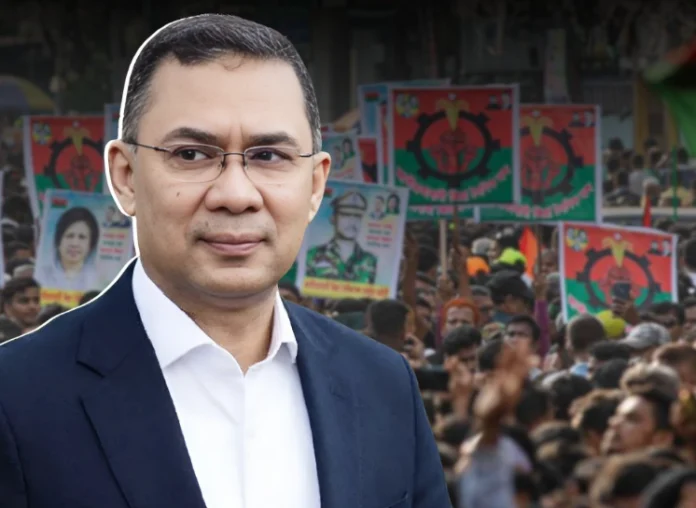
Bangladesh is set for national elections on February 12, 2026, and all eyes are on Bogura 6. Tarique Rahman, the acting chairman of the Bangladesh Nationalist Party (BNP), contests this key seat. Analysts view him as the frontrunner for the next prime minister. However, Tarique faces an unusual challenge: his father’s legacy. Sheikh Ziaur Rahman, the founder of BNP and former President of Bangladesh, casts a long shadow over the race.
Ziaur Rahman holds a contested place in Bangladesh’s history. Some see him as a strong military leader who helped secure independence in 1971, while others label him a dictator. Tarique’s opponent, Abdullah-al-Waki of the National Citizens Party (NCP), exploits this legacy. Waki claims that the BNP has strayed from Ziaur Rahman’s ideals and projects himself as the true inheritor of his politics. “Ziaur Rahman is not just the property of the BNP, he’s the Father of the Nation,” Waki told The Business Standard. He accuses BNP of compromising Ziaur’s principles after entering alliances with the Awami League.
The stakes are high. Khaleda Zia, former Prime Minister and Tarique’s mother, remains critically ill on life support. Surveys suggest that over 47% of Bangladeshis believe Tarique is the likely next prime minister if BNP wins. The party has a strong base in Bogura 6, a seat historically held by BNP and previously won by Khaleda Zia. Yet Waki aims to disrupt that dominance using Ziaur Rahman’s legacy to attract voters.
Another contender, Shafiqur Rahman of Bangladesh Jamaat-e-Islami, also contests from Bogura 6, but the primary contest remains between Tarique and Waki.
Ziaur Rahman’s political journey shapes this election. Before 1971, he served in the Pakistan Army and won the second-highest military decoration for his role in the 1965 India-Pakistan War. During Bangladesh’s Liberation War, Ziaur defected to support the Mukti Bahini and announced Bangladesh’s independence on March 27, 1971. Post-independence, he became Chief Martial Law Administrator, then President in 1977, and founded BNP in 1978 to stabilize the country and promote Bengali nationalism. His reforms ended one-party rule, allowed political competition, and initiated broad economic reforms. Opposition within the armed forces, however, led to his assassination in 1981.
After Ziaur Rahman’s death, Khaleda Zia led BNP through turbulent political waters, including opposition to General Ershad’s military rule. Between 1991 and 2014, BNP under Khaleda, often in alliances, won three national elections.
Tarique’s return from London, where he has lived since 2007, signals his political ascendancy. He recently addressed BNP workers, stressing that only BNP could safeguard democracy in Bangladesh. Waki counters that BNP has deviated from its founder’s path, creating a direct ideological confrontation.
Bogura 6 remains a BNP stronghold, but Waki’s campaign makes it a high-stakes test. Observers see this contest as a litmus test for Tarique’s leadership and the BNP’s ability to maintain relevance. The February election will determine if Tarique can step out of his father’s shadow or if Ziaur Rahman’s legacy will continue to shape Bangladeshi politics in unexpected ways.