PM Modi lands on highway runway in Assam, sends strategic signal near China border
Prime Minister Narendra Modi on Saturday marked a major boost to India’s border infrastructure. He inaugurated a new Emergency Landing Facility on a highway in Upper Assam. Through this move, India strengthened its air defence preparedness near the China frontier.
The facility stands on the Dibrugarh-Moran stretch of National Highway 127. It lies less than 300 kilometres from the Line of Actual Control. Therefore, security experts view it as a strategic milestone.
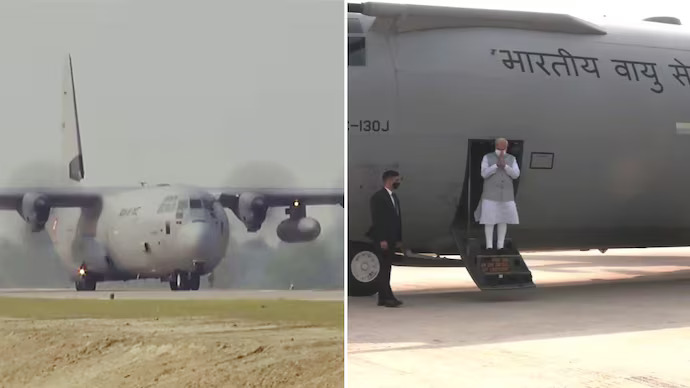
During the event, a fighter jet of the Indian Air Force took off from the highway strip. Senior officials and defence leaders witnessed the operation. The demonstration highlighted the readiness of India’s armed forces.
Meanwhile, officials confirmed that the Prime Minister’s aircraft also used the same stretch. He landed and later took off from the highway. He did not use the nearby Chabua Air Force Station. This step underlined confidence in the new facility.
The location of the runway adds to its importance. It lies close to Dibrugarh in Assam. In recent years, this region has seen rising strategic activity. As a result, the government has focused on improving defence logistics.
Earlier, India depended mainly on fixed airbases in the Northeast. However, such bases face risks during conflict. Enemy forces can target them. Weather conditions can also disrupt operations. Therefore, authorities planned alternative options.
This highway-cum-runway answers that need. It stretches across 4.2 kilometres. Engineers built it with reinforced concrete. It can support fighter jets and transport aircraft. It can also handle emergency civilian flights.
Notably, the stretch has no central divider. This design allows smooth aircraft movement. Authorities have installed fencing on both sides. They have also removed temporary roadside structures. These steps ensure safety during operations.
At the same time, defence planners see this facility as a backup. If airports or air bases face disruption, aircraft can still operate. This flexibility helps the air force respond quickly to emergencies.
Moreover, highway runways offer tactical advantages. They reduce dependence on limited bases. They increase operational surprise. They also complicate enemy planning. Therefore, many countries now adopt similar models.
Until now, India had such facilities mainly in western and northern regions. The Moran runway marks the first such project in the Northeast. Hence, it expands India’s strategic footprint toward the eastern frontier.
Officials said the project involved close coordination between civil agencies and the air force. Engineers followed strict technical standards. They tested surface strength, lighting systems, and emergency protocols before approval.
Meanwhile, defence analysts say the facility improves disaster response too. During floods or earthquakes, aircraft can land quickly. Relief supplies can reach remote areas without delay.
The government has also linked this project to broader infrastructure growth. Roads, bridges, and air connectivity now form part of national security planning. As a result, development and defence now move together.
Politically, the event sends a strong message. It shows India’s intent to protect its borders. It also reflects confidence in indigenous planning and execution.
In conclusion, PM Modi’s landing on the highway runway goes beyond symbolism. It demonstrates preparedness. It strengthens deterrence. It improves regional connectivity. Above all, it signals that India remains alert and ready along its sensitive eastern frontier.