Nuclear reactors, AI, Energy and Security: Key outcomes from PM Modi’s 2 hour talks with UAE President
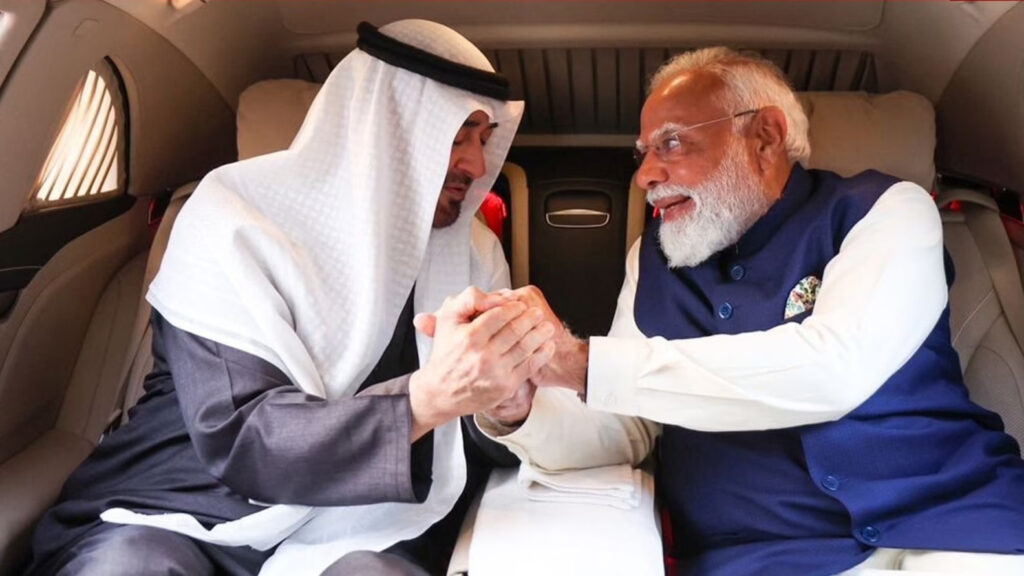
Prime Minister Narendra Modi held focused bilateral talks with UAE President Sheikh Mohamed bin Zayed Al Nahyan during a short but packed two-hour visit to India on Monday. The leaders reviewed the entire spectrum of ties. They pushed cooperation in nuclear energy, artificial intelligence, defence, trade, space and counter-terrorism. Consequently, both sides exchanged multiple agreements and letters of intent at delegation and restricted-level meetings.
The UAE delegation reflected the visit’s importance. It included members of the Abu Dhabi and Dubai royal families. Sheikh Hamdan bin Mohammed bin Rashid Al Maktoum, Crown Prince of Dubai and UAE Deputy Prime Minister and Defence Minister, also joined senior ministers. Therefore, the visit carried both political and strategic weight.
Energy Partnership Deepens
Energy security dominated early discussions. India and the UAE welcomed a new 10-year LNG supply agreement between Hindustan Petroleum and ADNOC Gas. Under the deal, ADNOC will supply 0.5 million tonnes of LNG annually from 2028. As a result, the UAE will emerge as one of India’s top LNG partners. Both leaders emphasized stable supplies amid global market swings.
Civil Nuclear Cooperation Expands
Next, the leaders widened their nuclear agenda. They agreed to explore collaboration on large nuclear reactors and Small Modular Reactors (SMRs). India recently enacted the SHANTI law to facilitate international partnerships in advanced nuclear technologies. Therefore, both sides now see new openings for cooperation. The talks also covered plant operations, safety frameworks and long-term maintenance.
AI and Digital Infrastructure Move Forward
Artificial intelligence formed another core pillar. The two countries agreed to jointly set up a supercomputing cluster in India. Additionally, they discussed UAE investment in India’s data-centre ecosystem. They also examined the concept of Digital Embassies to safeguard cross-border digital sovereignty. Sheikh Mohamed endorsed India’s proposal to host the AI Impact Summit in February 2026.
Defence and Security Get Strategic Push
Defence cooperation gained fresh momentum. Both sides signed a Letter of Intent for a Strategic Defence Partnership. The leaders highlighted growing military exchanges and recent joint exercises. Furthermore, they strongly condemned terrorism in all forms, including cross-border threats. They pledged closer coordination under FATF mechanisms to curb terror financing and money laundering.
Trade Targets Double
Economic ties also saw ambitious expansion. Bilateral trade has already crossed $100 billion for FY 2024-25 under the CEPA framework. Now both sides aim to raise that figure to $200 billion by 2032. They reviewed UAE participation in Gujarat’s Dholera Special Investment Region, including projects in airports, ports, renewable energy and smart urban infrastructure.
To boost MSMEs, the leaders urged faster rollout of Bharat Mart, Bharat-Africa Setu and the Virtual Trade Corridor. These platforms will link businesses across West Asia, Africa and Eurasia.
Space, Food and Community Links Strengthen
India and the UAE also launched plans for joint commercial ventures in space technology, satellite manufacturing and launch services. Meanwhile, both sides pushed cooperation in food security and agricultural supply chains. A forthcoming MoU on food safety standards will help Indian exporters and farmers.
The leaders acknowledged strong people-to-people ties. Around 4.5 million Indians live and work in the UAE. Therefore, both sides agreed to expand youth exchanges and set up a House of India in Abu Dhabi as a cultural hub.
Global Coordination
Finally, the leaders reviewed regional developments and reiterated support for peace in West Asia. The UAE expressed support for India’s BRICS chairmanship in 2026. India backed the UAE-hosted UN Water Conference.
Sheikh Mohamed thanked PM Modi for the warm welcome. The visit reinforced the steady rise of India-UAE strategic cooperation across critical sectors.