“We are in the AI era”: Supreme Court questions Centre over Sonam Wangchuk transcripts
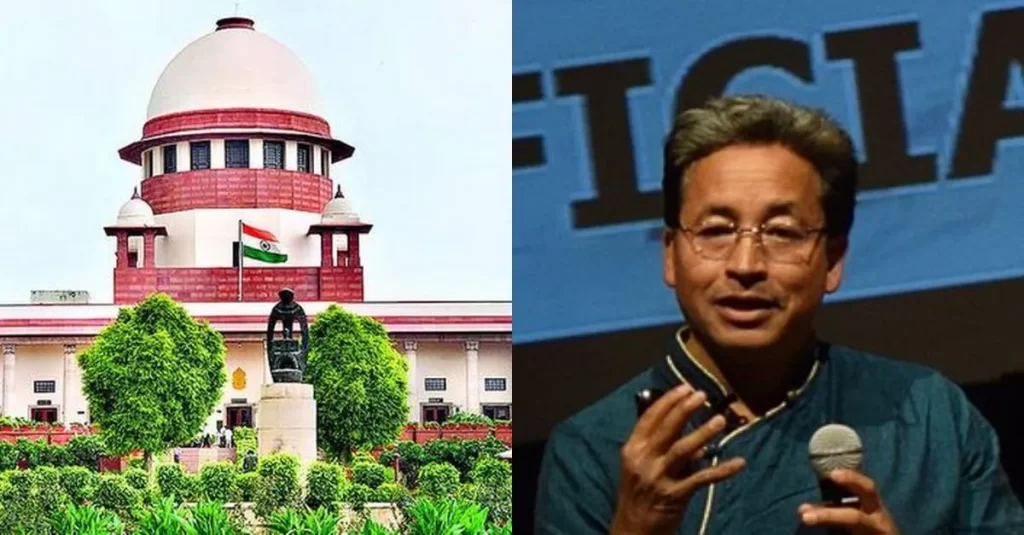
The Supreme Court of India on Monday strongly questioned the Centre over the accuracy of transcripts linked to activist Sonam Wangchuk. The court said faulty transcription raised serious concerns about fairness and intent.
First, a bench led by Justice Aravind Kumar and Justice P. B. Varale heard a habeas corpus plea. Wangchuk’s wife, Gitanjali Angmo, filed the petition. She challenged his detention under the National Security Act.
Next, Senior Advocate Kapil Sibal presented the Centre’s transcripts in court. He pointed out major discrepancies. He said officials inserted words and phrases that Wangchuk never used. He denied that Wangchuk spoke about self-immolation or overthrowing the government.
Then, the bench examined the documents. Judges noted that some claims did not appear in the detention order. They said several lines lacked factual support. They questioned how a three-minute speech turned into a seven- or eight-minute transcript.
After that, the court addressed Additional Solicitor General K. M. Nataraj. It asked him to submit original and accurate transcripts. The bench stressed that detention orders must rely on verified material.
The judges made their position clear. They said long and distorted transcripts suggested deliberate exaggeration. They called it “certain malice.” They also said authorities must maintain consistency between speeches and official records.
When the government lawyer said a department prepared the transcripts and lacked expertise, the court rejected the explanation. It said, “We are in the era of AI.” It added that accuracy must reach at least 98 percent. The bench stressed that modern tools leave little room for major errors.
Meanwhile, Sibal sharpened his attack. He argued that the Centre relied on imaginary statements. He questioned how officials could claim “subjective satisfaction” based on false material. He said the administration built its case on words that never existed.
Then, he highlighted Wangchuk’s protest record. He said Wangchuk spoke about promises of statehood and constitutional safeguards. He said Wangchuk demanded action through peaceful means. He added that Wangchuk chose hunger strikes and marches, not violence.
Sibal also pointed out that no speech since 2022 encouraged unrest. He said the case did not involve incitement or public disorder. He urged the court to consider Wangchuk’s consistent commitment to non-violence.
During the hearing, the bench quoted a couplet in a lighter moment. It said authorities “heard what was never said.” Sibal replied that officials ignored what the defence actually stated.
Later, the court issued fresh directions. It asked jail authorities in Jodhpur to submit a pendrive containing original recordings of Wangchuk’s speeches. It ordered officials to place the device in a sealed box and present it in court.
Background facts also shaped the case.
Since 2023, Wangchuk has protested climate change impacts on Ladakh. He has demanded Sixth Schedule protections for the region. In September last year, he began a 35-day fast for statehood. Violence broke out during the protest, leading to four deaths. Wangchuk later called off the fast and urged youth to avoid violence.
In conclusion, the court’s remarks sent a strong signal. It stressed accuracy, transparency, and accountability. It warned authorities against careless or biased documentation. The case now hinges on original recordings and verified transcripts. The next hearing will determine whether the detention stands on solid legal ground.