“Traitor Friend” remark triggers political storm as Rahul Gandhi, Ravneet Bittu clash in Parliament
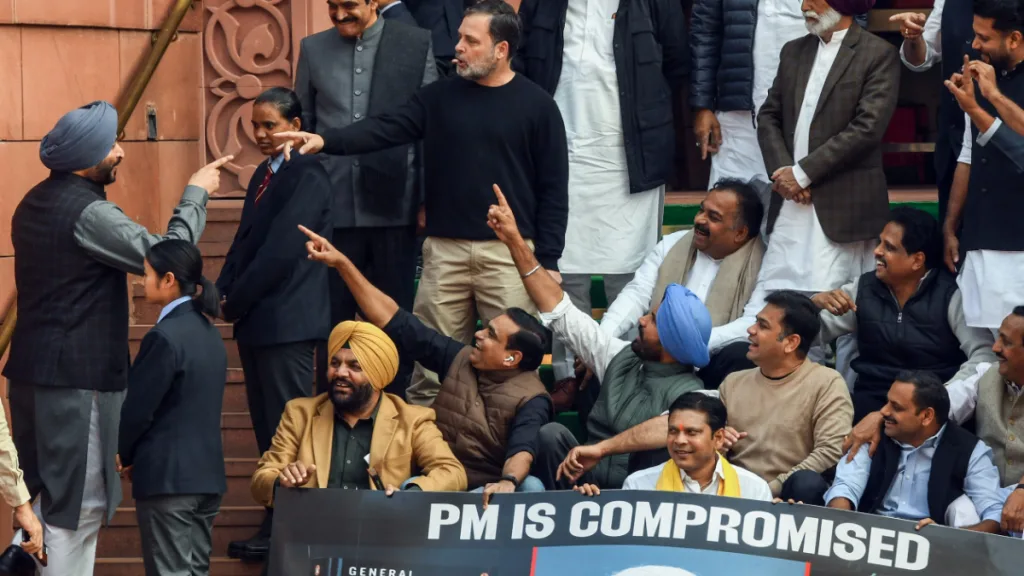
A sharp political clash unfolded in Parliament on Wednesday morning. Leader of Opposition Rahul Gandhi and Union Minister Ravneet Singh Bittu exchanged heated words during a protest by Congress MPs. The argument quickly drew national attention and triggered a fresh political row.
First, Congress lawmakers gathered near the Makar Dwar. They protested the suspension of eight Opposition MPs from the Lok Sabha. They raised slogans and demanded action from the Speaker. They accused the government of silencing dissent.
Meanwhile, Ravneet Singh Bittu walked past the protesting members. At that moment, Rahul Gandhi addressed him directly. He called Bittu a “traitor friend.” He pointed toward him and made the remark in front of party colleagues and media persons.
Next, Gandhi extended his hand. He offered a handshake. He added, “Hello, brother. My traitor friend. Don’t worry, you will come back.” His comment referred to Bittu’s exit from the Congress and his move to the BJP before the 2024 elections.
However, Bittu rejected the gesture. He refused to shake hands. He responded sharply. He called Gandhi “desh ke dushman,” or enemy of the nation. He also criticised the protesting MPs. He said they sat “as if they won a war.”
Soon after, the verbal exchange spread across political circles. Leaders from both parties reacted strongly. Supporters on social media also joined the debate.
Later, Bittu explained his reaction to reporters. He accused the Gandhi family of harming Sikh interests. He referred to Operation Blue Star in 1984. He also mentioned the anti-Sikh riots that followed. He said these events shaped his views.
Bittu stated that he would never shake hands with the Gandhi family. He said he considered them responsible for past injustices against Sikhs. He described Gandhi’s remarks as insulting and unacceptable.
Then, in an interview, Bittu claimed that Gandhi tried to provoke him. He alleged aggressive behaviour. He said he would consult BJP leaders. He also said he might seek a privilege motion against Gandhi in Parliament.
Meanwhile, Sikh leaders reacted strongly. Delhi minister Manjinder Singh Sirsa condemned Gandhi’s “traitor” remark. He said Sikhs could never betray the nation. He accused the Congress of disrespecting the community. He added that the party mindset had not changed.
At the same time, members of the Sikh community staged a protest outside the Congress headquarters. They demanded an apology. They accused the party of targeting Sikh leaders unfairly.
On the other hand, the Congress defended Gandhi. Party leaders argued that Bittu had betrayed the organisation by switching sides. They said strong words reflected political reality. They questioned why Gandhi did not get enough time to speak in Parliament.
Congress MP Amarinder Singh Raja Warring supported the remark. He said no better word suited a betrayer. He also blamed the ruling party for creating tension in the House.
The clash took place against a tense parliamentary backdrop. Earlier in the day, the Lok Sabha suspended eight Opposition MPs. Authorities suspended them for the rest of the Budget Session. Officials cited rule violations and disorderly conduct.
The suspended MPs include Hibi Eden, Raja Warring, Manickam Tagore, Gurjeet Aujla, Prashant Padole, Chamala Reddy, Dean Kuriakose, and CPM leader S Venkatesan. Their suspension triggered widespread protests.
In recent weeks, Parliament has seen frequent disruptions. Opposition parties accuse the government of suppressing debate. The ruling alliance counters these claims and cites repeated rule-breaking.
The Gandhi-Bittu exchange reflects this growing tension. It highlights deep political divisions. It also shows rising personal attacks in public spaces.
Going forward, both sides plan to escalate the issue. The BJP may pursue formal action. The Congress may continue protests. Political observers expect more confrontations in the coming days.
For now, the “traitor friend” remark has added fuel to an already heated session. It has shifted focus from policy debates to personal conflict. And it has once again exposed the fragile atmosphere inside Parliament.