SpaceX delays ISS mission to bring stranded NASA astronauts home
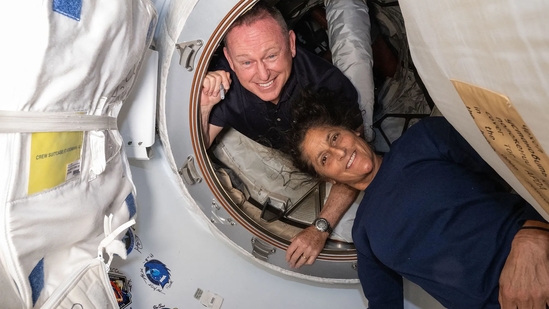
(FILES) This undated handout picture from Nasa released on July 2, 2024 shows NASAs Boeing Crew Flight Test astronauts (from top) Butch Wilmore and Suni Williams inside the vestibule between the forward port on the International Space Stations Harmony module and Boeing's Starliner spacecraft. NASA needs to decide by the end of August whether to return two astronauts to Earth aboard Boeing's Starliner, which flew them to the International Space Station (ISS), or bring them home on a SpaceX craft, officials said on August 14, 2024. NASA astronauts Barry "Butch" Wilmore and Sunita "Suni" Williams blasted off for the ISS on Starliner on June 5 for what was meant to be an eight-day stay. (Photo by Handout / NASA / AFP) / RESTRICTED TO EDITORIAL USE - MANDATORY CREDIT "AFP PHOTO / NASA" - NO MARKETING NO ADVERTISING CAMPAIGNS - DISTRIBUTED AS A SERVICE TO CLIENTS
SpaceX postponed Crew-10’s launch on Wednesday due to a last-minute issue with the rocket’s launchpad. The mission aimed to send four astronauts to the International Space Station (ISS) and bring home Butch Wilmore and Sunita Williams. The two have been stranded in space for nine months after Boeing’s Starliner malfunctioned.
Officials halted the launch during the countdown but did not announce a new date. NASA had fast-tracked the mission by two weeks after pressure from President Donald Trump and SpaceX CEO Elon Musk. They pushed for an earlier return for Wilmore and Williams.
Wilmore and Williams, both Navy test pilots, were initially set for an eight-day stay. However, Boeing’s Starliner failed, forcing them to extend their mission. The capsule returned to Earth without them.
A SpaceX rocket was scheduled to launch from Kennedy Space Center at 7:48 p.m. ET (2348 GMT). The new crew includes two U.S. astronauts, a Japanese astronaut, and a Russian cosmonaut.
NASA confirmed that Wilmore and Williams remain safe while assisting with ISS research. On March 4, Williams shared her eagerness to reunite with her family and dogs. “It’s been a roller coaster for them, probably more than for us,” she said.
Crew-10’s mission, originally routine, has taken on political significance. Trump and Musk blamed the delay on President Joe Biden’s administration, despite no evidence. Their intervention in NASA’s operations was unusual.
NASA initially planned Crew-10’s launch for March 26 but moved it up by swapping in a ready SpaceX capsule. Once the new crew reaches the ISS, Wilmore, Williams, NASA astronaut Nick Hague, and Russian cosmonaut Aleksandr Gorbunov will return using a Crew-9 capsule docked since September.
NASA insists Wilmore and Williams must stay until Crew-10 arrives to maintain ISS operations. The astronauts reached the station in June as part of Boeing’s Starliner test flight. However, propulsion malfunctions made returning unsafe, prompting NASA to plan their return via SpaceX instead.
Boeing developed Starliner under a $4.5 billion NASA contract as a SpaceX competitor. The 2023 mission was its first crewed test flight, a crucial step toward certification for regular missions. However, Starliner has faced technical setbacks and budget overruns since 2019.
Meanwhile, SpaceX’s Crew Dragon, developed under a similar $4 billion NASA contract, has operated successfully since 2020. It remains the only U.S. spacecraft currently used for ISS crew rotations.