“Respect must guide leadership”: Macron reacts after Trump leaks private texts amid diplomatic row
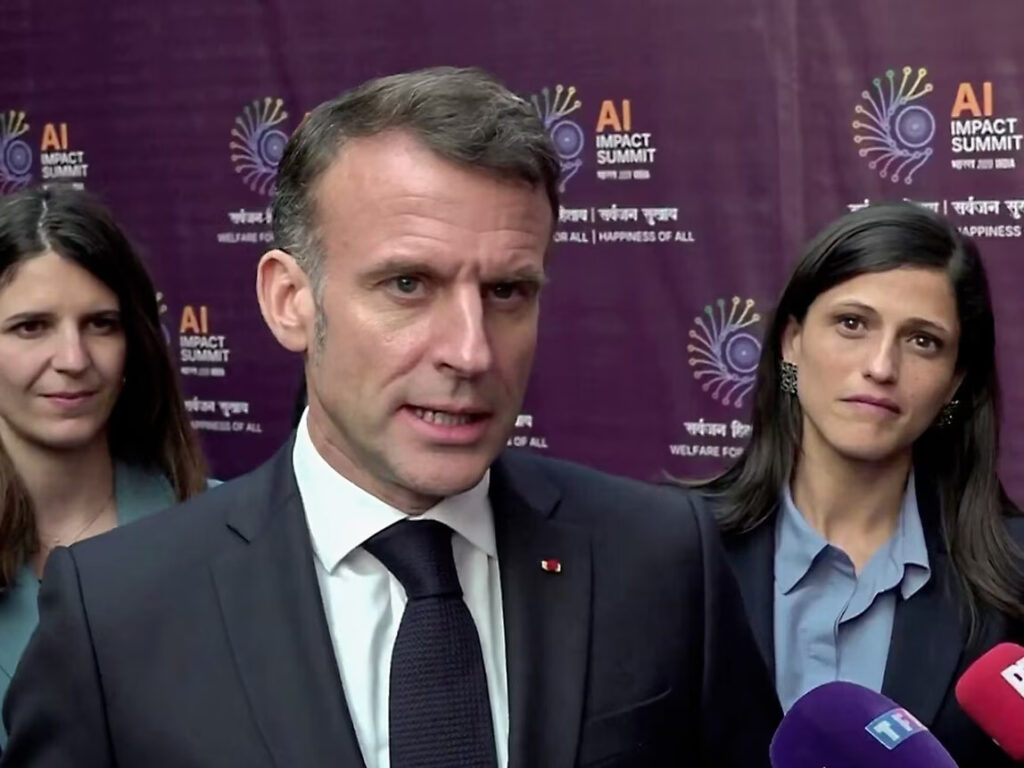
French President Emmanuel Macron has responded sharply after US President Donald Trump shared private text messages between them. Macron said leaders must uphold respect and avoid hostility. He made the remarks during his three-day visit to India.
First, Macron joined Indian podcaster Raj Shamani on the show “Figuring Out.” During the conversation, he addressed Indo-French ties and global politics. Then the discussion shifted to his ongoing dispute with Trump. When asked about the leaked messages, Macron avoided direct criticism. However, he stressed the importance of dignity in diplomacy.
“I believe respect defines leadership,” Macron said. He added that leaders may disagree, but they must express differences respectfully. According to him, democracy allows debate without hatred or aggression. Therefore, no leader needs to adopt violence or insult as tools of politics.
Macron expanded on this point. He argued that democratic systems give citizens the power to choose their leaders. Voters decide who frames and passes laws. As a result, political change does not require hostility. “There is no need to be violent and disrespectful,” he said firmly.
Moreover, Macron expressed concern about the tone of global politics. When asked whether the world should fear the direction of American leadership, he responded carefully. He said societies have built respect and civility over decades. Leaders, he noted, strengthened institutions through patience and dialogue. Consequently, he found it surprising when leaders appear to move “backwards” in the civilisational process.
He warned that such behaviour sends the wrong signal globally. In his view, international stability depends on mutual trust. Without trust, alliances weaken and misunderstandings grow. Therefore, he urged leaders to preserve the standards that democratic societies developed over generations.
The controversy began after France declined Trump’s invitation to join the “Board of Peace.” Trump created the board to focus on rebuilding Gaza. However, France and several other nations questioned the initiative. They pointed out that the board’s charter did not clearly address the broader Israel-Palestine conflict. Paris raised concerns about long-term political solutions.
Soon after France declined participation, tensions escalated. Trump threatened to impose 200 percent tariffs on French wines and champagne. He told reporters that such trade pressure could push France to reconsider its position. The statement added a trade dimension to the diplomatic dispute.
Then the situation intensified further. Trump posted private text exchanges with Macron on his social media platform, Truth Social. In those messages, Macron appeared to express concerns about US interest in Greenland. The public release of private communication drew attention across diplomatic circles.
Although Macron did not respond to the content of the texts directly, his remarks underscored his frustration. He focused instead on principles. He framed the issue as one of leadership standards rather than personal grievance. Through this approach, he attempted to shift the narrative toward democratic values.
Meanwhile, the episode highlights broader strains between Washington and several European capitals. Trade disputes, geopolitical strategies and differing approaches to Middle East policy continue to test alliances. Despite this friction, Macron signaled that dialogue remains possible.
In India, Macron continued discussions on strategic cooperation and global governance. He emphasized partnership over confrontation. At the same time, he reiterated that leaders must model restraint and responsibility.
As the dispute unfolds, Macron’s message remains clear: disagreement belongs in diplomacy, but disrespect does not.