OBC Quota Dispute: SC Rules Against Revanth Reddy Government
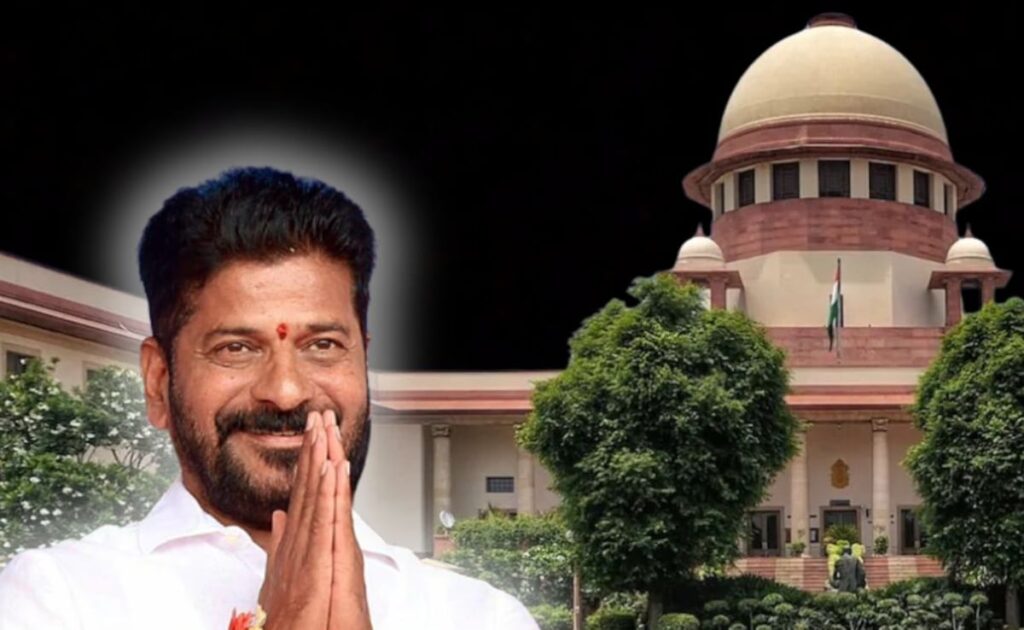
The Supreme Court on Thursday rejected Telangana government’s plea challenging the High Court’s interim stay on expanded OBC reservations. The stay halted the increase beyond the 50 per cent cap set by the top court in its 1992 Indra Sawhney ruling.
The state had sought to raise OBC quotas to 42 per cent for local body elections, which would have pushed total reservations to 67 per cent. Senior advocate Abhishek Manu Singhvi, representing Chief Minister Revanth Reddy, argued that the move was a policy decision supported unanimously by the legislature.
Singhvi told Justices Vikram Nath and Sandeep Mehta, “How can it be stayed without pleadings? Barring the first few pages, no reasons have been given for the stay. Who are these people to stay it when it was passed unanimously by the legislature?”
On concerns about exceeding the 50 per cent cap, Singhvi said, “There is a misconception that the Indra Sawhney case established a rigid 50 per cent limit. The judgment allows breaches in exceptional circumstances.” He maintained that the government acted within its powers.
Senior advocate Gopal Sankaranarayanan, appearing for the High Court, defended the interim stay. He cited previous Supreme Court judgments that reinforced the 50 per cent ceiling. “The order we challenged increased OBC reservations to 42 per cent, which takes the total well over 60 per cent,” he said, referencing the 2010 K Krishna Murthy Constitution Bench ruling.
The High Court order, delivered last month by Chief Justice Aparesh Kumar Singh and Justice GM Mohiuddin, arose from petitions challenging three government orders. One order introduced the 42 per cent OBC quota, while the other two outlined guidelines for implementing reservations.
The High Court noted that the increase appeared to breach the 50 per cent cap. It invoked the Supreme Court’s “triple test” for exceptions, which requires: forming a commission to conduct an empirical study, determining reservation proportions based on the study, and ensuring total reservations do not exceed 50 per cent across SC, ST, and OBC categories.
The High Court found that the government failed the test prima facie. Consequently, it stayed all three orders until it reaches a final decision on their legality.
Observers say the case underscores ongoing tension between state policies and Supreme Court precedents on reservation limits. Telangana had argued that social justice demands warranted higher quotas, while legal experts caution that exceeding the cap without proper study risks setting a contentious precedent.
The Supreme Court’s refusal to lift the stay signals that any expansion of OBC quotas must adhere to the established legal framework. Both the state government and petitioners now await a full hearing. Analysts note that the case could shape future reservation policies not just in Telangana, but across India.