MNS sides with Shinde Sena, alliance cracks deepen as Mayor races trigger political churn across Maharashtra
Political tension is rising across Maharashtra after civic body election results. Parties are now scrambling to secure mayoral control. As a result, old alliances are under strain. New equations are taking shape. Power games have intensified at the local level.
Across cities, leaders are courting rival corporators. They are testing loyalty. They are also using pressure tactics. This churn has surfaced in Kolhapur, Chandrapur, Malegaon, Kalyan-Dombivli, Ulhasnagar, and Mumbai. The mayor race has become the main battleground.
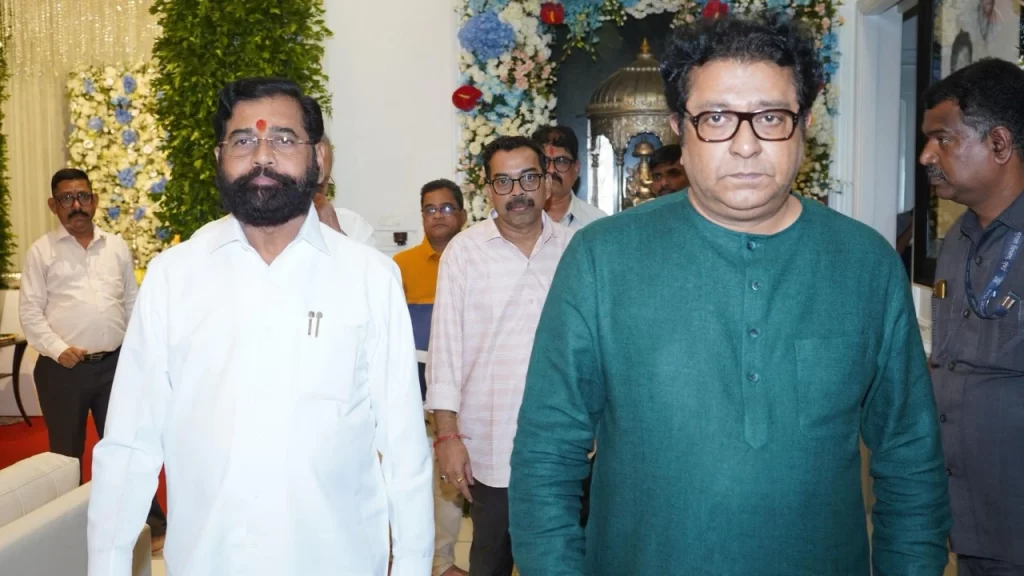
Most notably, Raj Thackeray’s Maharashtra Navnirman Sena has backed the Eknath Shinde-led Shiv Sena in the Kalyan-Dombivli Municipal Corporation. This move has altered the local power balance. It has also unsettled the emerging understanding between the Thackeray cousins.
In Kalyan-Dombivli, the Shinde Sena is pushing hard for a majority. The MNS support has strengthened that effort. At the same time, it has weakened Uddhav Thackeray’s position. The Shiv Sena (UBT) has struggled to keep its ranks intact in the civic body.
Further complicating matters, four of the 11 Shiv Sena (UBT) corporators in KDMC went out of contact after the results. This development fueled speculation of defections. Soon after, the party announced the return of Sarita Mhaske, a newly elected Mumbai corporator. She had earlier remained unreachable amid rumors of a switch to the Shinde camp.
Meanwhile, Shiv Sena (UBT) leader Sanjay Raut addressed the MNS support issue. He said he spoke directly to Raj Thackeray. According to Raut, Raj Thackeray expressed distress over the decision. He claimed local leaders took the call. He also clarified that the MNS leadership did not issue a formal directive.
However, the political damage has already set in. The move has raised doubts about future cooperation between the Thackeray factions. It has also strengthened Shinde’s bargaining power in key civic bodies.
At the same time, cracks are emerging within the Shiv Sena–BJP alliance. Both parties fought the civic polls together in some regions. Yet post-result negotiations have caused friction. In Kalyan, Shinde’s aggressive push has reportedly upset BJP leaders.
In Ulhasnagar, tensions are sharper. The Shiv Sena and BJP fought separately there. The 78-member house has produced a fractured mandate. The BJP has 37 seats. The Shiv Sena has 36. The majority mark stands at 40.
To bridge the gap, the Shinde Sena has secured support from three corporators. Two belong to Prakash Ambedkar’s Vanchit Bahujan Aghadi. One is an independent. This strategy has allowed Shinde to move ahead without BJP backing.
Elsewhere, the BJP and Congress are locked in open conflict. In Chandrapur, the Congress has emerged as the single largest party with 27 seats. The BJP follows closely with 23. The Congress has accused the BJP of reaching out to independents, Shiv Sena (UBT) members, and Congress corporators to retain power.
In response, senior BJP leader Sudhir Mungantiwar acknowledged talks with other parties. He claimed several Congress corporators were in touch with the BJP. He said the party’s focus remains on city development.
However, both parties face internal rifts. In the BJP, factions led by Mungantiwar and Kishore Jorgewar are at odds. In the Congress, groups aligned with Vijay Wadettiwar and Pratibha Dhanorkar are pulling in different directions.
Overall, the mayor race has exposed fragile alliances. It has also highlighted deep internal divisions. As negotiations continue, Maharashtra’s civic politics remains volatile. The final shape of power may depend less on mandates and more on last-minute deals.