India, US sign 10-Year Defence Framework in Kuala Lumpur, boost strategic ties amid ongoing trade yalks
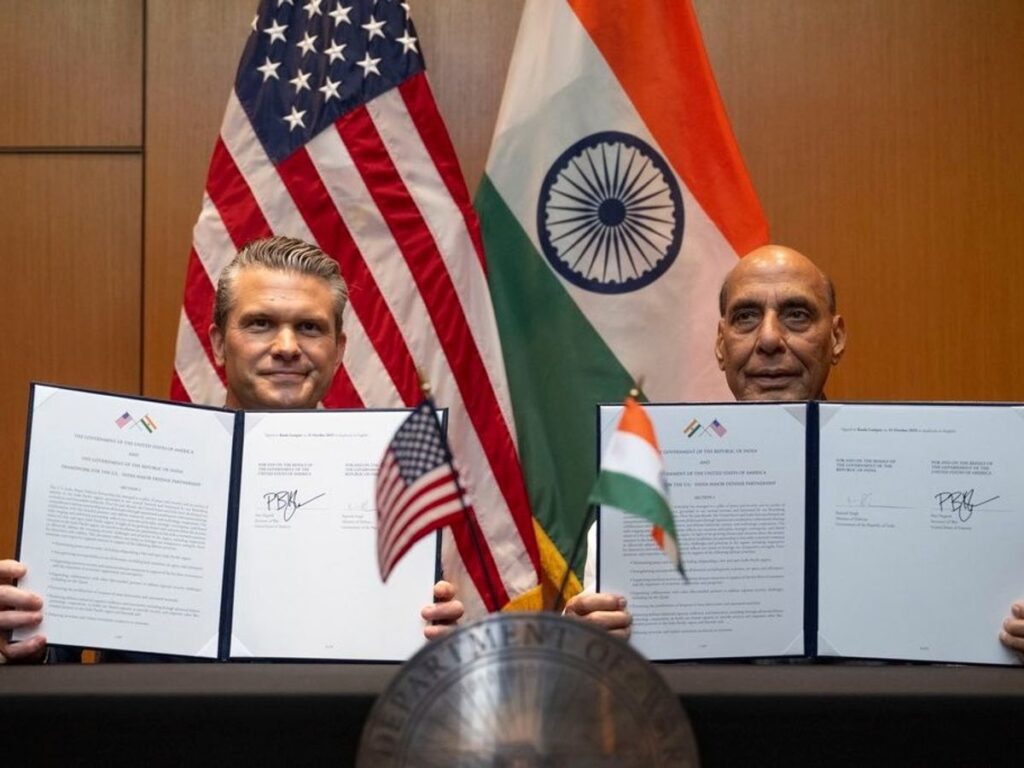
Kuala Lumpur, Malaysia — In a major push to deepen military cooperation, the United States and India signed a 10-year Defence Framework on Friday. US Secretary of War Pete Hegseth and Defence Minister Rajnath Singh formalized the agreement during their meeting in Kuala Lumpur. Hegseth said the partnership between the two nations “has never been stronger.”
The signing took place alongside the second ASEAN-India Defence Ministers’ Informal Meeting. The event was held on the sidelines of the ASEAN Defence Ministers’ Meeting-Plus (ADMM-Plus), scheduled for November 1.
Strengthening Defence Partnership
After the meeting, Hegseth posted on X that he met Rajnath Singh to seal the long-term pact. He described the agreement as a “cornerstone for regional stability and deterrence.” He added that the framework expands coordination, information sharing, and technology cooperation between the two militaries.
“This ambitious 10-year roadmap marks a major step forward,” Hegseth said. “It reflects America’s long-term commitment to shared security and a free, prosperous Indo-Pacific.” He thanked Singh for India’s consistent partnership and highlighted the “mutual trust” that anchors the relationship.
According to the US official, the new defence framework lays out clear plans for future collaboration in areas like joint training, maritime security, cyber defence, and emerging technologies. “We’re not just building defence ties; we’re shaping a strategic future together,” Hegseth noted.
India’s Role in Regional Security
Rajnath Singh echoed similar views during the ASEAN informal meeting. He said India aims to strengthen defence and security cooperation with ASEAN nations under the “Act East Policy.” He also reaffirmed New Delhi’s commitment to maintaining peace and stability in the Indo-Pacific region.
Singh’s engagement with Hegseth came just days after External Affairs Minister S. Jaishankar met US Secretary of State Marcon Rubio in Kuala Lumpur. The two discussed regional developments and the broader India-US partnership.
Trade Talks and Global Challenges
The defence agreement coincides with active trade negotiations between New Delhi and Washington. Tensions rose earlier this month after President Donald Trump doubled tariffs on Indian goods in response to India’s continued oil trade with Russia.
At the East Asia Summit on Monday, Jaishankar voiced India’s concern over rising energy restrictions and supply disruptions. “Energy trade is becoming constricted, creating market distortions,” he said. “Principles must apply equally, and global rules cannot be selective.” His remarks indirectly referred to the US tariffs and Western sanctions affecting India’s energy imports.
Jaishankar also urged global cooperation to address conflicts in Gaza and Ukraine. “The world must adopt zero tolerance for terrorism and ensure stability in energy and food supply chains,” he said.
Trade Dialogue Continues
Meanwhile, Union Commerce Minister Piyush Goyal emphasized that India will not rush into trade deals. He stated that New Delhi seeks balanced, trust-based agreements rather than short-term benefits. “India will not sign any deal in haste,” Goyal said. “Trade is not just about tariffs; it’s about long-term partnerships.”
He confirmed that Indian and US teams are holding detailed discussions. “Talks are progressing well,” Goyal said. “We are working toward a fair and equitable agreement.”
A Strategic Turning Point
The back-to-back high-level meetings underline a renewed momentum in India-US ties. With the new 10-year defence pact, both nations aim to strengthen military and strategic cooperation while addressing trade and energy concerns.
As tensions reshape global alignments, the India-US partnership continues to emerge as a key pillar of security and stability in the Indo-Pacific region.