El Mencho killed in military raid; violence erupts across Mexico
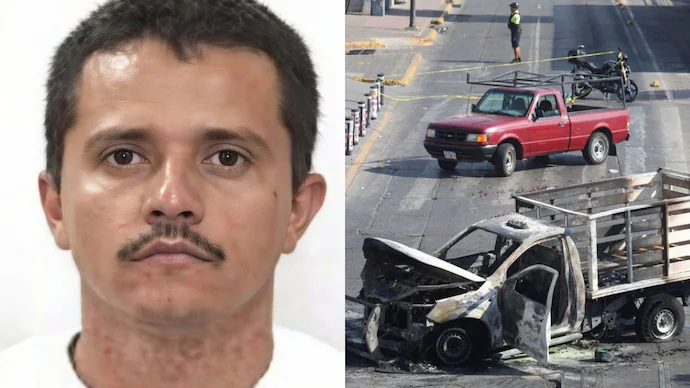
Nemesio Ruben Oseguera Cervantes, widely known as El Mencho, died after a military raid in western Mexico. Authorities confirmed his death on Sunday. He led the powerful Jalisco New Generation Cartel for more than a decade. Security forces had pursued him for years.
First, troops launched an operation in the state of Jalisco. They targeted a suspected hideout linked to the cartel’s leadership. During the clash, Oseguera suffered serious injuries. Officials then moved him by air toward Mexico City. However, he died before doctors could stabilise him.
As news spread, violence flared in several regions. Gunmen torched vehicles. They blocked highways with burning trucks. Armed groups forced drivers to abandon cars. Residents reported road closures in multiple states. Most incidents occurred in cartel strongholds.
Soon after, smoke rose above parts of Puerto Vallarta. Witnesses shared videos that showed panic near the airport. In Guadalajara, flames consumed cars left across major roads. Traffic came to a halt. Businesses shut their doors early. Schools dismissed students as a precaution.
In response, President Claudia Sheinbaum addressed the nation through social media. She said federal forces worked in full coordination with state authorities. She urged calm and promised order. Meanwhile, Jalisco Governor Pablo Lemus Navarro asked residents to remain indoors until security forces restored control.
For years, El Mencho ranked among the world’s most wanted traffickers. The United States government offered a reward of 15 million dollars for information that led to his capture. Prosecutors accused him of directing shipments of cocaine, methamphetamine, and fentanyl into North America. His organisation expanded rapidly and challenged older cartels for territory.
Over time, CJNG built a reputation for firepower and coordination. Fighters often traveled in armoured convoys. They used heavy weapons. They posted videos to intimidate rivals. As a result, the group tightened control over key trafficking corridors. It also extended operations into several foreign markets.
Unlike the once-dominant Sinaloa Cartel, which gained notoriety under Joaquín “El Chapo” Guzmán, CJNG grew fast and operated with aggressive tactics. Security analysts viewed Oseguera as a strategist who mixed business discipline with violent enforcement. Consequently, his network became one of the most influential criminal syndicates in Mexico.
Meanwhile, pressure from Washington intensified in recent months. US officials urged Mexico to increase action against drug trafficking. Some American lawmakers discussed stronger cross-border measures. In that climate, Mexican forces stepped up operations against cartel figures.
After confirmation of Oseguera’s death, US Deputy Secretary of State Christopher Landau called the development significant for regional security. He said cooperation between both countries remained vital. Shortly afterward, the US State Department issued alerts for American citizens in several Mexican states. Authorities advised them to shelter in place during security operations.
Canada released a similar warning for travelers in Puerto Vallarta. Officials recommended caution and limited movement in affected areas.
Although authorities celebrate the fall of a major cartel leader, questions remain. Power struggles may follow. Rival factions could attempt to seize territory. Security experts warn that short-term instability often follows the removal of a dominant figure.
For now, federal forces continue patrols across Jalisco and neighboring states. Roadblocks remain under watch. Officials promise swift action against any group that disrupts public order. The government aims to prevent further escalation while maintaining pressure on organised crime networks nationwide.