Delhi shifts schools to hybrid mode as pollution crisis deepens under GRAP-3 restrictions
New Delhi – The Delhi government has directed all schools to switch to a hybrid mode of classes for students up to Class 5, responding to a sharp rise in air pollution. The decision came after the Centre activated Stage III of the Graded Response Action Plan (GRAP) across the National Capital Region (NCR) on Tuesday.
The Commission for Air Quality Management (CAQM) took the step as Delhi’s Air Quality Index (AQI) worsened from the ‘very poor’ to the ‘severe’ category. The AQI, recorded at 362 on November 10, surged to 425 by 9 a.m. on November 11 due to calm winds and stagnant weather conditions.
The CAQM said the situation required urgent intervention to prevent further decline. Therefore, it implemented all measures under GRAP Stage III, which applies when AQI levels range between 401 and 450.
Key Restrictions Under GRAP-3
The new restrictions include a complete ban on construction and demolition activities that generate dust. This includes earthwork, masonry, welding, painting, road repair, and tile cutting. Authorities have also prohibited the loading, unloading, and transport of dust-producing materials on unpaved roads.
The movement of diesel vehicles faces strict limits too. Delhi and NCR authorities have banned BS-III petrol and BS-IV diesel light motor vehicles (LMVs) in Delhi, Gurugram, Faridabad, Ghaziabad, and Gautam Buddha Nagar. Delhi-registered diesel medium goods vehicles with BS-III or lower standards cannot operate. Similarly, diesel light commercial vehicles (LCVs) of BS-III or below, registered outside Delhi, are barred from entering the city.
Only electric, CNG, or BS-VI diesel interstate buses from NCR states may enter Delhi. Exemptions apply only to All India Tourist Permit buses and tempo travellers.
Steps to Protect Public Health
The Delhi government has also ordered schools to adopt a hybrid mode, allowing online classes for younger students. Officials said this decision prioritises children’s health, as prolonged exposure to toxic air may cause respiratory illnesses.
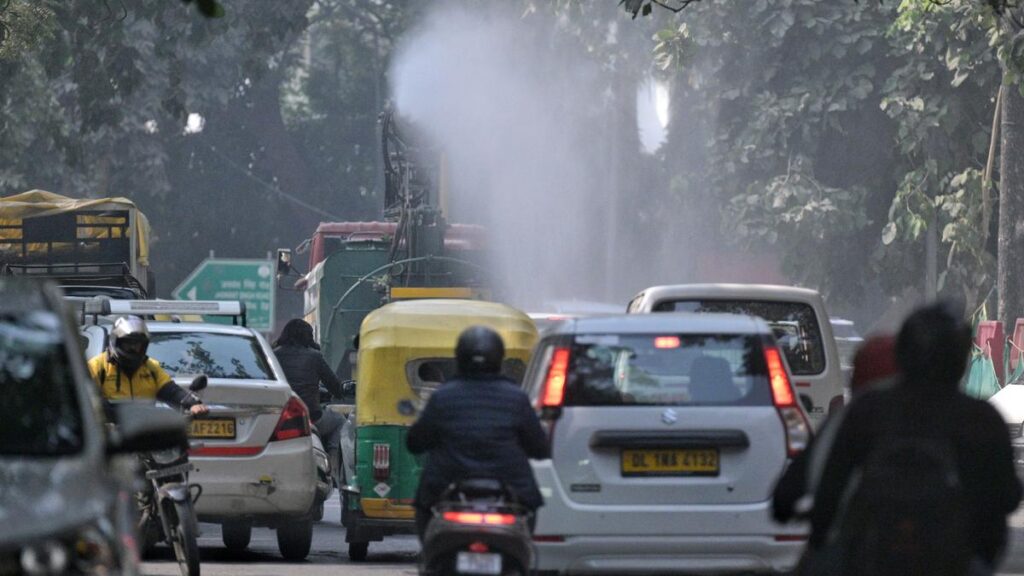
Authorities have intensified mechanised road sweeping and dust control operations. The government has also asked agencies to strengthen public transport and consider differential fare systems to discourage private vehicle use. In addition, all stone crushers and mining activities across NCR have been shut down.
Delhi’s Worsening Air Quality
Delhi’s pollution problem worsens each winter as weather patterns trap pollutants. Experts link the current spike to vehicular emissions, dust from construction sites, and stubble burning in neighbouring states.
Environmental scientists warn that exposure to high AQI levels can trigger breathing problems and worsen conditions such as asthma and bronchitis. The CAQM said the latest measures aim to stabilise the situation before it reaches the “severe plus” level under Stage IV.
As the capital continues to choke under thick smog, the government urges citizens to limit outdoor activity and support pollution-control efforts.