Delhi AQI nears ‘severe’ as smog thickens, visibility drops, and airport issues advisory
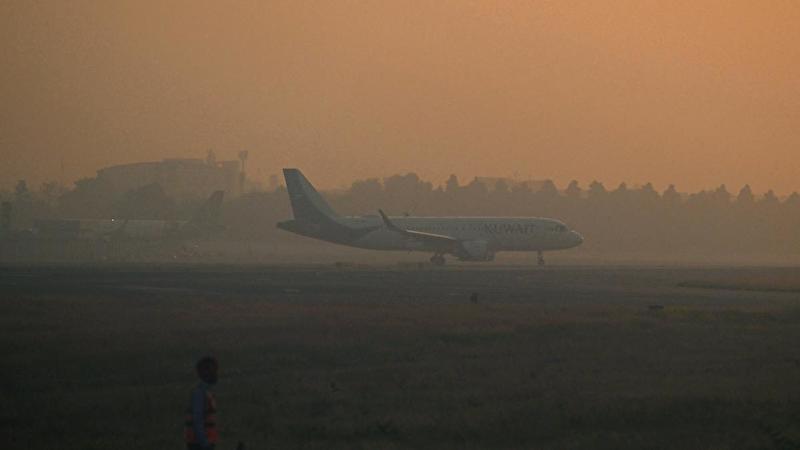
Delhi’s air quality worsened sharply on Saturday and edged close to the ‘severe’ category, as the city’s average Air Quality Index climbed to 387. This rise erased the brief relief that residents experienced earlier in the week and signalled a return to hazardous conditions.
Early in the day, thick smog mixed with shallow fog covered large parts of the capital. As a result, visibility dropped significantly and prompted low-visibility procedures at Indira Gandhi International Airport. However, flight operations continued without disruption, airport authorities said.
Meanwhile, pollution hotspots across the city recorded alarming readings. Eighteen locations reported AQI levels above 400, which falls in the ‘severe’ category. Wazirpur topped the list with an AQI of 443. Jahangirpuri followed closely at 439, while Vivek Vihar recorded 437. Rohini and Anand Vihar each logged 434. Ashok Vihar stood at 431, while Sonia Vihar and the Delhi Technological University area reported 427 each.
In addition, several other areas crossed the severe threshold. Narela posted an AQI of 425, Bawana 424, and Nehru Nagar 421. Patparganj touched 419, ITO reached 417, and Punjabi Bagh stood at 416. Mundka recorded 415, Burari Crossing 413, and Chandni Chowk 412. The North Campus area of Delhi University also slipped into the severe bracket with an AQI of 401.
Earlier this week, Delhi saw a temporary improvement after nine straight days of ‘very poor’ air. On Tuesday, the average AQI dropped to 282 and moved into the ‘poor’ category. Conditions improved further on Wednesday, when the AQI fell to 259. However, the relief proved short-lived. The index rose to 307 on Thursday, worsened to 349 on Friday, and climbed further on Saturday, according to Central Pollution Control Board data.
At the same time, the pollution crisis spread across the National Capital Region. Ghaziabad and Noida recorded AQI levels of 422 each, firmly in the severe zone. Gurugram reported an AQI of 295, while Faridabad stood at 208. Both cities remained in the ‘poor’ category.
Visibility continued to suffer due to the dense smog layer. The India Meteorological Department reported visibility around 500 metres in New Delhi. Although the weather office did not issue a dense fog alert for Delhi-NCR, it sounded an orange alert for very dense fog in eastern Uttar Pradesh. Parts of Punjab, including Amritsar, reported near-zero visibility in some pockets.
Looking ahead, weather officials warned that dense fog may persist over the next two days across Uttar Pradesh, Haryana, Punjab, and Delhi-NCR. Low wind speeds from the east have trapped pollutants close to the ground and intensified the impact.
Experts linked the deterioration to unfavourable weather conditions. Low wind speeds, high moisture levels, and falling temperatures have restricted pollutant dispersion. At the same time, Delhi has yet to experience a strong winter chill. The minimum temperature hovered near 11 degrees Celsius on Saturday, while the maximum stayed close to 22 degrees.
Meteorologists attributed the delayed winter to the absence of active western disturbances, which usually bring cold and dry winds to north India. This absence has allowed stagnant air to persist and pollution levels to rise.
Amid growing concern, the Commission for Air Quality Management formed an expert committee to curb vehicular pollution in Delhi-NCR. Authorities identified vehicle emissions, including PM2.5, nitrogen oxides, and carbon monoxide, as a major contributor to the crisis.
Officials urged residents to limit outdoor activity and take precautions as hazardous air quality continues across Delhi and much of the NCR.