BJP’s Dilip Ghosh demands central forces for Bengal polls, cites tensions during voter roll revision
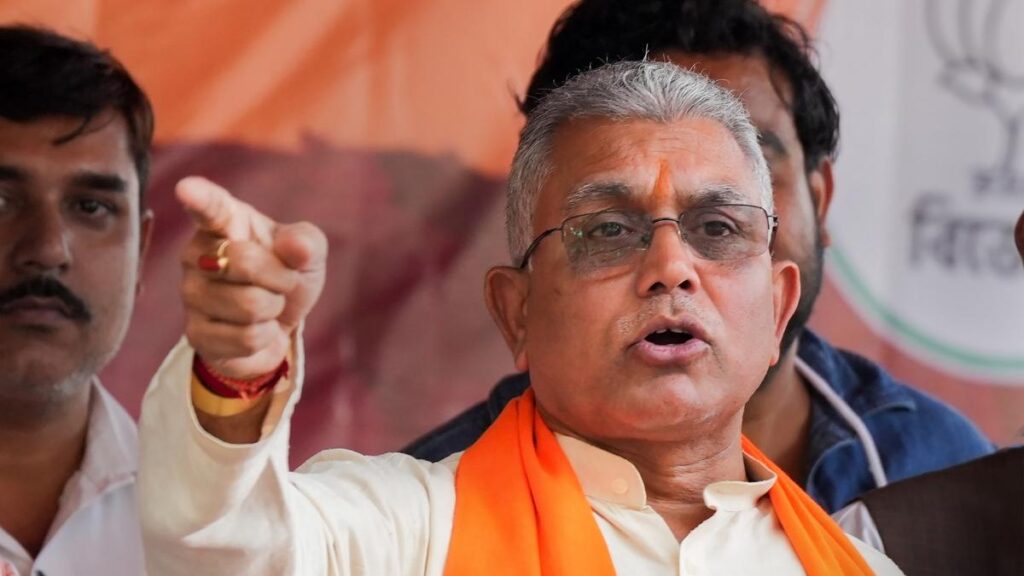
BJP leader Dilip Ghosh on Saturday insisted that authorities must deploy central forces to conduct elections in West Bengal. He argued that the state cannot hold free and fair polls without such deployment. He linked his demand to tensions during the ongoing Special Intensive Revision (SIR) of voter rolls.
First, Ghosh pointed to unrest during the SIR exercise. He said political clashes and local tensions surfaced in several areas. Therefore, he claimed the administration cannot rely solely on state machinery. He stressed that elections involve large-scale mobilization. Moreover, he said political rivalry in Bengal often triggers conflict. For that reason, he argued that central forces ensure neutrality and security.
He described the election process as a “difficult task.” He added that past experiences show the need for stronger security arrangements. According to him, central forces help create voter confidence. He maintained that voters must feel safe when they step out to cast their ballots.
Meanwhile, Ghosh also spoke about the BJP’s “Parivartan Yatra.” He alleged that the state government has denied permission for the political march. However, he asserted that the party has secured court approval. Therefore, he said the BJP will proceed with the yatra despite administrative hurdles.
He claimed that people in Bengal want political change. He said the upcoming election offers that opportunity. In addition, he accused the ruling dispensation of trying to obstruct opposition outreach programs. Still, he expressed confidence that public support will drive the campaign forward.
On the other hand, Chief Minister Mamata Banerjee raised concerns over the same SIR process earlier this week. She claimed that officials may delete nearly 1.20 crore names from the electoral rolls. She described the matter as a serious democratic issue. Furthermore, she said the concern goes beyond party politics and religious identity. According to her, the integrity of voter lists directly affects citizens’ rights.
Earlier, the state government welcomed a key judicial decision on the verification process. The Supreme Court of India allowed the Chief Justice of the Calcutta High Court to deploy additional civil judges. The court specified that judges must have at least three years of experience. If necessary, the Chief Justice can also seek assistance from counterparts in neighboring high courts.
A bench led by Chief Justice of India Surya Kant issued the directions. The Chief Justice of the Calcutta High Court had earlier flagged a shortage of officers. He noted that authorities must verify over 50 lakh objections under the “Logical Discrepancy” category within a fixed timeline.
The High Court assessed the scale of the task. It observed that even 250 judicial officers would need around 80 days to complete verification. Therefore, the court sought additional support to ensure timely scrutiny. The state government welcomed this intervention. It said the move will streamline the verification process.
Thus, the debate over central force deployment now intersects with concerns about voter roll accuracy. The BJP demands stronger security. The state government defends its administrative framework. At the same time, the judiciary monitors the verification exercise. As elections approach, political tensions continue to shape the narrative in West Bengal.