Lok Sabha clears President’s address without PM reply, first time since 2004
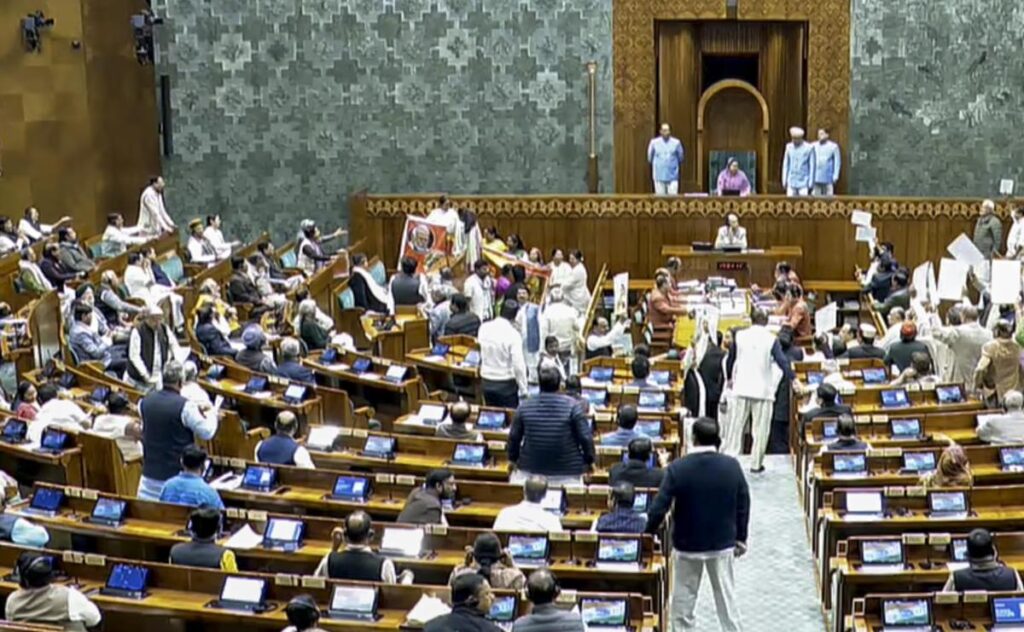
In a rare development, the Lok Sabha on Thursday approved the Motion of Thanks on President Droupadi Murmu’s address without the Prime Minister’s reply. Notably, this marked the first such instance since 2004. Usually, the Prime Minister responds before the House adopts the motion. However, persistent protests altered the process this time.
At the start of the Budget Session, President Murmu addressed a joint sitting of Parliament on January 28. She outlined the government’s priorities. She focused on economic growth, welfare schemes, national security, and governance reforms. After this address, both Houses began a formal debate, as per tradition.
Next, the Lok Sabha scheduled Prime Minister Narendra Modi’s reply for Wednesday.
The government prepared for the concluding phase of the discussion. Ministers took their seats early. Party leaders coordinated floor strategy. Meanwhile, opposition parties raised multiple demands. They sought debates on unemployment, inflation, federal issues, and recent political disputes.
Soon, slogans filled the House.
Opposition MPs moved into the Well. They shouted against the Centre. They targeted the Prime Minister. They accused the government of suppressing dissent. As a result, proceedings slowed down. Speaker Om Birla repeatedly appealed for order. He urged members to allow debate. Yet, protests continued.
Consequently, the Speaker adjourned the House.
With no improvement in order, the Prime Minister lost his chance to reply. The House could not resume normal business. Later, Speaker Om Birla read out the Motion of Thanks to the President. He then put it to a voice vote. Despite loud slogans, the House cleared the motion.
Soon after, the Speaker adjourned the sitting till 2:00 PM.
Meanwhile, disorder returned on Thursday morning.
The Lok Sabha met at 11 am. However, INDIA bloc MPs again raised slogans. They accused the Centre of silencing the opposition. They targeted Prime Minister Modi. They demanded justice for Leader of the Opposition Rahul Gandhi.
According to opposition leaders, the Chair denied Gandhi the right to speak. They also said the House blocked him from quoting former Army chief General M. M. Naravane’s unpublished memoir on the 2020 China standoff. Therefore, they intensified their protests.
In response, government leaders rejected these claims.
They said the Chair followed rules. They accused the opposition of creating chaos. They argued that protests aimed to disrupt the Budget Session. Moreover, they claimed that repeated adjournments hurt public interest.
Tensions had already risen earlier in the week.
On Tuesday, the House suspended eight Congress MPs for unruly conduct. The suspension covered the rest of the Budget Session. After that decision, protests grew stronger. Opposition members staged walkouts. They blocked proceedings. They demanded revocation of the suspensions.
As a result, confrontation deepened.
Political observers linked the turmoil to long-standing rivalry. They noted rising polarization in Parliament. They also pointed to shrinking space for structured debate. Over recent years, frequent disruptions have reduced legislative productivity. This episode added another example.
Meanwhile, leaders recalled a similar episode from 2004.
That year, BJP members prevented then Prime Minister Manmohan Singh from replying to the Motion of Thanks. Later, in March 2005, Singh referred to the incident in Parliament. Recently, Congress leader Jairam Ramesh shared a video of that speech on X. He highlighted the historical parallel.
For now, the House has completed the formal process.
The Motion of Thanks stands approved. The Budget Session continues. However, the absence of the Prime Minister’s reply remains significant. It denies the House a final political response. It also limits public understanding of the government’s position.
Ultimately, the episode reflects a deeper challenge.
Political confrontation continues to overshadow parliamentary dialogue. Unless parties restore discipline and trust, such rare departures from tradition may become more frequent in the future.