India stays away as Trump launches ‘Board of Peace’ on Gaza at Davos
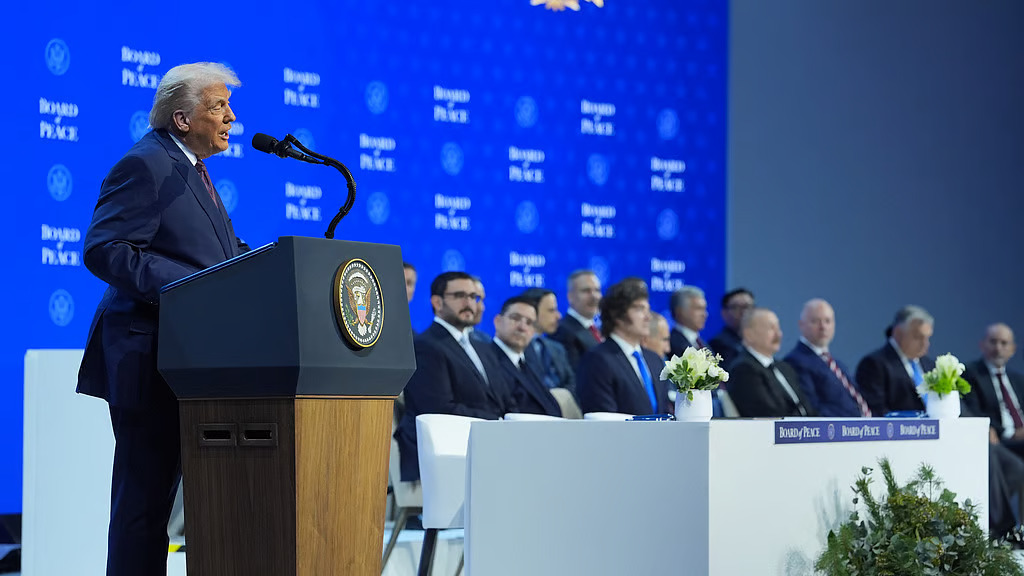
India stayed away as US President Donald Trump launched his proposed “Board of Peace” in Davos on Thursday. Trump unveiled the body on the sidelines of the World Economic Forum in Switzerland. He pitched the board as a platform to promote peace in Gaza. However, its broad mandate quickly drew global attention and concern.
To begin with, no Indian official attended the launch event. Sources confirmed that India received an invitation last week. Around 60 countries got similar invitations. Yet, New Delhi has not taken a final call on joining the board. Officials said India continues to study the proposal and its implications.
At the same time, the absence of key global players stood out. No permanent member of the UN Security Council, apart from the US, joined the board. Likewise, no G7 country other than the US signed on. This limited participation raised questions about the board’s credibility and intent.
Meanwhile, Trump used the Davos stage to highlight his foreign policy claims. He presided over a signing ceremony and repeated his assertion that he had ended eight wars in nine months. He again cited last year’s India-Pakistan military standoff. Trump claimed his intervention helped stop escalation between the two nuclear-armed neighbours.
Pakistan took part in the ceremony. Prime Minister Shehbaz Sharif joined leaders from other countries and signed the board’s documents. Trump said Sharif praised him for saving millions of lives. Pakistan Army chief Field Marshal Asim Munir also attended the event. Sharif even pointed him out to Trump during the ceremony.
India, however, rejected Trump’s claims earlier. New Delhi said the fighting ended after four days. Indian and Pakistani military commanders reached an understanding through direct talks. Indian officials have maintained that no third party played a role.
As details emerged, concerns around the board deepened. The official charter made no direct reference to Gaza. Instead, it outlined a wide and open-ended role. The document said the board would promote stability and lasting peace in conflict zones. Critics fear this mandate could overlap with or weaken existing international institutions.
Trump added to those concerns through his remarks. He said the board could expand its work beyond Gaza. He also suggested the body could take on other global crises. He made it clear that he sees himself as the driving force behind it. Trump said the board could work alongside the UN. Yet, he stressed that the UN had no role in the conflicts he claimed to have resolved.
So far, leaders from 11 countries signed the launch documents. These included Argentina, Armenia, Azerbaijan, Bulgaria, Hungary, Indonesia, Kazakhstan, Kosovo, Pakistan, Paraguay, and Uzbekistan. Senior officials from eight other nations also joined. These included Bahrain, Jordan, Morocco, Qatar, Saudi Arabia, Turkey, the UAE, and Mongolia.
India watched these developments closely. Officials tracked the positions of partners such as France and Russia. At the same time, they flagged concerns. One concern focused on the board potentially undermining the UN. Another focused on Trump remaining chairman without a defined term.
The board’s Gaza plan also raised eyebrows. Trump’s son-in-law Jared Kushner, a member of the executive board, outlined a development-focused vision. He spoke about rebuilding Gaza. However, he did not mention a Palestinian state. The Gaza executive board links to the second phase of a US-brokered Israel-Hamas agreement. The first phase, a ceasefire reached last October, has already seen repeated violence.
Looking ahead, India plans its own diplomatic engagement. New Delhi will host Arab League foreign ministers on January 30 and 31. Officials will discuss Gaza and regional stability. On Thursday, foreign secretary Neena Malhotra met Arab League envoys to prepare for the talks. Prime Minister Narendra Modi may also visit Israel in February. That visit could open space for deeper consultations on West Asia.